The San Diego Mosque Attack, Part I: What Happened
Three people were killed at the Islamic Center of San Diego on May 18th in what authorities are investigating as a hate crime. But before the identities of those killed had even been publicly confirmed, a second event was already unfolding online. Within minutes of the attack, far-right commentators, MAGA influencers, and accounts with long histories of anti-Muslim rhetoric began flooding social media with conspiracy theories, misinformation, and ideological spin designed to redirect blame and reshape public perception of what had happened.
What emerged in those first hours was not simply confusion or the ordinary chaos that follows breaking news, t was narrative capture. Competing versions of reality formed almost immediately: one grounded in witness testimony, police statements, footage from the scene, and the accounts of people inside the mosque, and another built out of internet rumor, reactionary grievance politics, and a digital culture that increasingly treats mass violence as an opportunity for ideological performance.
By the time gunfire erupted at the Islamic Center of San Diego, the warning signs had been piling up for years.
According to court records, one of the two gunmen had become openly obsessed with mass shootings, Nazi ideology, and some of the most notorious white supremacist killers in recent history. Classmates reported concerns after he began dressing as mass murderers, including the perpetrator of the racist 2019 El Paso Walmart massacre and the Norwegian neo-Nazi terrorist who murdered 77 people in 2011.
At one point, police conducted a welfare check after the teenager allegedly warned a friend not to come to school the next day. Investigators later documented an escalating fixation on mass shootings, Adolf Hitler, and World War II. According to court filings, he claimed to be researching material on the dark web because he believed it could not be traced back to him. Authorities also reported that he expressed admiration for Hitler and suggested the Nazi leader had "redeeming qualities."
These were not vague warning signs. They were explicit concerns involving Nazi sympathies, admiration for mass killers, and a growing fascination with far-right extremist violence.
Authorities eventually placed the teenager on a 72-hour psychiatric hold and sought a temporary gun violence restraining order. Court records show family members later claim to have removed more than two dozen firearms from the home and attempted multiple interventions, including therapy and increased supervision.
After fleeing from the mosque, and before the pair committed murder-suicide, they also shot at a landscaper named Tafu Letuli between 5 and 6 times while he was working. In a statement issued by his lawyer, he says if it wasn’t for his helmet he would likely not be alive today as one bullet struck him in the center of his arbors helmet.
Yet, in the immediate aftermath, as investigators and researchers worked to establish a motive, an unhinged alternate reality was already spreading online. Far-right accounts were already attempting to force the attack into preexisting racist "culture war" narratives. Some posts openly celebrated the violence. Others attempted to blame Muslims themselves. Many focused on spreading false claims that the shooters were transgender, alleging without evidence that authorities and the media were concealing the attackers’ identities in order to protect a politically convenient narrative.
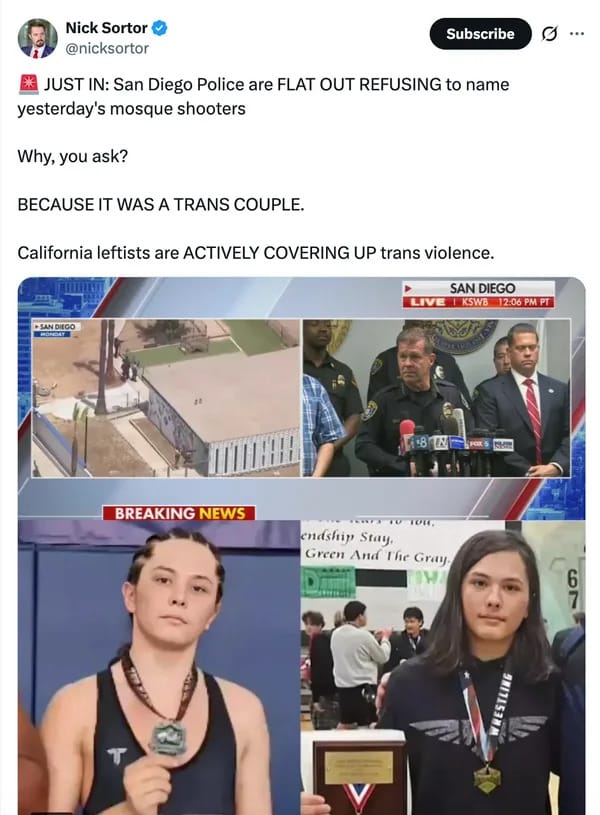
These “transvestigation” claims spread rapidly across Twitter, Telegram, and other platforms tied to far-right online communities. The claims were entirely unfounded, but that did little to slow their circulation. In the current online media environment, speed matters more than accuracy. Once a narrative gains traction, corrections rarely travel with the same intensity as the original lie.
Some viral posts focused heavily on remarks made during an early police press conference, when officials stated: “What you will not hear from us today is the names of these two suspects. Today is about the victims and our community coming back together again.” Almost immediately, far-right accounts reframed the statement as evidence of a deliberate cover-up. In reality, authorities publicly identified the 17 and 18 year old suspects later that same day through an official announcement.
Investigators later stated that the two had met online before discovering they lived in the same geographic area.
According to investigators, the two shooters arrived at the Islamic Center armed with rifles, where Amin Abdullah, a longtime security guard at the mosque, confronted the attackers after realizing what was happening. Authorities say the shooters initially passed Abdullah before he reacted, opened fire, and simultaneously radioed for the mosque to enter lockdown.
Even after being wounded, Abdullah reportedly continued exchanging gunfire with the attackers, forcing them back into the parking lot and buying time for people inside the mosque and school to respond. He was later killed outside the building.
Community members and investigators alike later credited the rapid lockdown procedure with preventing a significantly larger massacre. Approximately 140 children were inside the school connected to the Islamic Center at the time of the shooting. By the time the attackers re-entered portions of the building, much of the school had already been secured or evacuated.
Authorities stated that after retreating outside, the shooters encountered two additional community members: Mansour Kaziha and Nadir Awad. According to investigators, both men attempted to confront or distract the attackers in an effort to protect others inside the mosque. Kaziha was reportedly able to call 911 before he was killed.
All three men, Amin Abdullah, 51, Nadir Awad, 57, and Mansour Kaziha, 78, were killed while attempting to intervene, slow the attackers, and protect the people around them as chaos unfolded.
Community members described Abdullah as deeply committed to protecting the mosque and the people inside it. According to mosque leaders, years of hate mail and threats had led the Islamic Center to strengthen security measures, including cameras and guards like Abdullah.
Awad reportedly lived directly across the street from the mosque and attended prayers there regularly. Community members said that when he heard gunfire erupt from the Islamic Center, he ran toward the building where his wife worked as a teacher at the affiliated school.
“He left his home trying to do something to help,” one community member said during a vigil held after the attack.
Kaziha, affectionately known as Abu Ezz, was remembered by community members as someone central to daily life at the mosque. Friends described him as a caretaker, handyman, cook, and constant presence within the Islamic Center, someone who helped hold the community together through ordinary acts of labor and care.
At vigils following the attack, many in attendance emphasized that the actions of all three men reflected the values that defined the mosque community itself: collective responsibility, mutual protection, and care for others in moments of crisis.
“They really represented everything that’s beautiful about Islam and everything that is beautiful about Muslims,” one community member said.
In the days following the shooting, investigators reported recovering at least 30 firearms, ammunition, and a crossbow from two residences connected to the suspects. Authorities stated they were also investigating whether the pair may have been considering additional targets beyond the mosque itself. WWFU has also reviewed a manifesto attributed to the shooters that describes plans extending beyond the mosque attack.
Even before the existence of a manifesto became widely discussed online, multiple details emerging from the investigation pointed toward ideological and racial motivation. According to reports, anti-Islamic writings were found inside the shooters’ vehicle, hate speech had been written directly onto at least one firearm used during the attack, and one of the suspects allegedly left behind writings referencing “racial pride.”
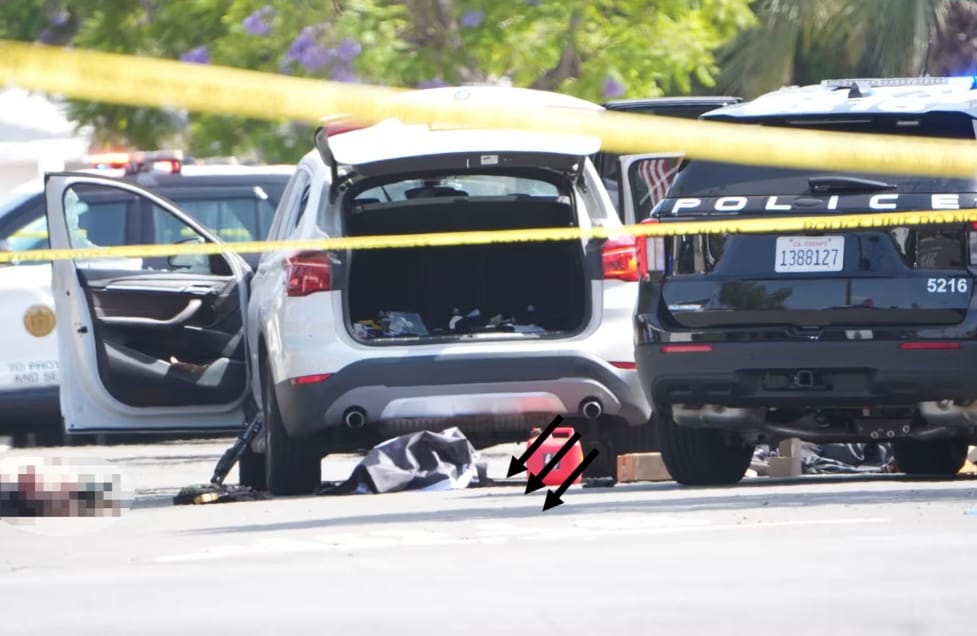
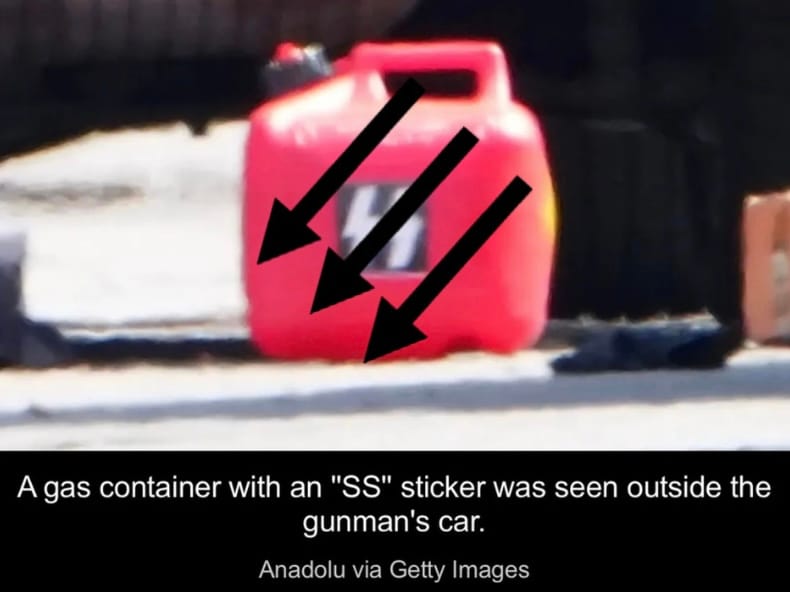
Near the vehicle where the shooters later died by murder-suicide, photographers documented a gas can marked with SS symbols referencing the Schutzstaffel, the paramilitary organization central to Nazi Germany. Investigators also reportedly recovered Nazi imagery and white supremacist symbolism throughout materials connected to the attackers.
In the manifesto, Muslims were described as needing to be “exterminated.” That language did not emerge in isolation.
For decades, Muslim and Arab communities have been positioned within American political discourse as permanent sites of suspicion. The so-called “War on Terror” normalized mass surveillance, racial profiling, and the framing of entire communities as security threats. In recent years, anti-Muslim and anti-Arab rhetoric has increasingly merged with broader far-right conspiracy culture, anti-immigrant politics, and anti-Palestinian dehumanization.
The result is a political atmosphere in which extremist violence does not need to invent hatred from scratch. It inherits narratives that already circulate openly across media, politics, and digital culture, then pushes those narratives toward their most violent conclusions.
The attack itself is now the subject of a criminal investigation. But understanding how two teenagers arrived at a worldview that celebrated Nazi symbolism, glorified mass killers, and called for the extermination of Muslims requires looking beyond the events of May 18.
It requires examining the online ecosystems where contemporary white supremacist violence is cultivated, circulated, and celebrated.
Read more about this online ecosystem in part 2:
 Alissa Azar
Suggested Reading
Learn more about far right threats and recognizing far right groups, symbols, and dog whistles here:
 We Will Free Us