May Day, Haymarket, and the Erasure of Anarchist History
Most people know May Day as “International Workers’ Day.” Fewer know why it exists at all.
Today, it’s often reduced to a vague celebration of labor. Parades, speeches, symbolic gestures. A holiday without teeth. But May Day was not born from abstract ideals or bureaucratic declarations. It was forged in open class conflict, through strikes, state violence, and the execution of anarchists.
To understand May Day, you have to start in Chicago, 1886.
The Conditions That Made Revolt Inevitable
Following the Civil War, particularly after the Long Depression, industrial production expanded rapidly across the United States. Chicago became one of its central hubs, powered largely by immigrant labor. Tens of thousands of immigrant workers filled factories, often as little as $1–$2 a day, with workweeks commonly exceeding 60 hours.
Conditions were brutal and unstable. Workers faced constant injury, poverty wages, and the ever-present threat of being replaced. Employers enforced control through blacklisting, lockouts, strikebreakers, and the use of private security forces and spies. They also deliberately stoked ethnic divisions between workers, weaponizing anti-immigrant sentiment to fracture organizing efforts.
Mainstream newspapers aligned themselves with business interests, while labor and immigrant presses became key sites of resistance. Chicago didn’t just become a center of industry, it became a battleground over who would control it.
The Eight-Hour Movement
In the late 19th century, workers across the United States were engaged in a mass struggle for the eight-hour workday. At the time, 10–16 hour shifts were standard. The demand for “eight hours for work, eight hours for rest, eight hours for what we will” was not reformist, it was explosive.
The Federation of Organized Trades and Labor Unions declared that May 1st, 1886 would mark the beginning of a new standard: “Eight hours shall constitute a legal day’s labour.”
Workers took that seriously. Figures like August Spies, editor of the anarchist newspaper Arbeiter-Zeitung (Workers’ Newspaper), helped organize mass meetings, print agitation materials, and turn demands into coordinated action. For them, the eight-hour fight wasn’t the end goal, it was a step toward dismantling wage labor itself. Albert Parsons, Spies, and other organizers toured factories and mass meetings, building toward a coordinated strike.
Between April 25 and May 4, workers attended a wave of marches and mass meetings across the city. On May 1st, around half a million workers struck nationwide. In Chicago alone, between 35,000 and 60,000 workers walked off the job to go on strike, while tens of thousands more flooded the streets in solidarity.
The massive march proceeded, led by anarchist Albert Parsons (editor of The Alarm, the most prominent anarchist newspaper in English at the time), his wife and fellow organizer Lucy Parsons, and their children.
Chicago became the epicenter of this movement, and anarchists were at its forefront.
Much of that anarchist movement was made up of immigrant workers, including many Germans who brought with them radical political traditions shaped by repression in Europe. Their organizing was not abstract theory, it was rooted in lived experience.
At the same time, anti-labor hysteria was inseparable from anti-immigrant racism. Anarchists were routinely depicted as foreign agitators, dangerous outsiders bringing violence and instability to American soil. This framing would become central to how the events of Haymarket were understood and weaponized.
May 3rd: The McCormick Massacre
The turning point came on May 3rd at the McCormick Harvester factory in Chicago. Rather than concede to workers’ demands, the company hired scabs. That day, striking workers asked Spies to speak at a nearby meeting.
As Spies urged workers to unite and not give in to the bosses, scabs began leaving the factory. Workers then moved towards the factory gates, forcing the scabs back inside the factory. At that moment, approximately 200 police officers rushed in to protect the factory and scabs. Without warning, police attacked the crowd, beating workers with clubs and opening fire with pistols.
At least two workers were killed, some were reportedly shot in the back as they fled, and many more were wounded. Some newspapers reported the number of those killed being as high as six.
It was a message: the state would enforce the bosses’ terms with violence.
The response in the press was immediate and coordinated. Newspapers cast striking workers as a violent “mob,” often placing the term “workingmen” in quotation marks to undermine their legitimacy. One New York paper described anarchism as a “villainous teaching” whose influence had led directly to bloodshed.
This marked the early formation of what would become known as the Red Scare: a moral panic in which radical labor movements were framed not as political actors, but as existential threats requiring suppression.
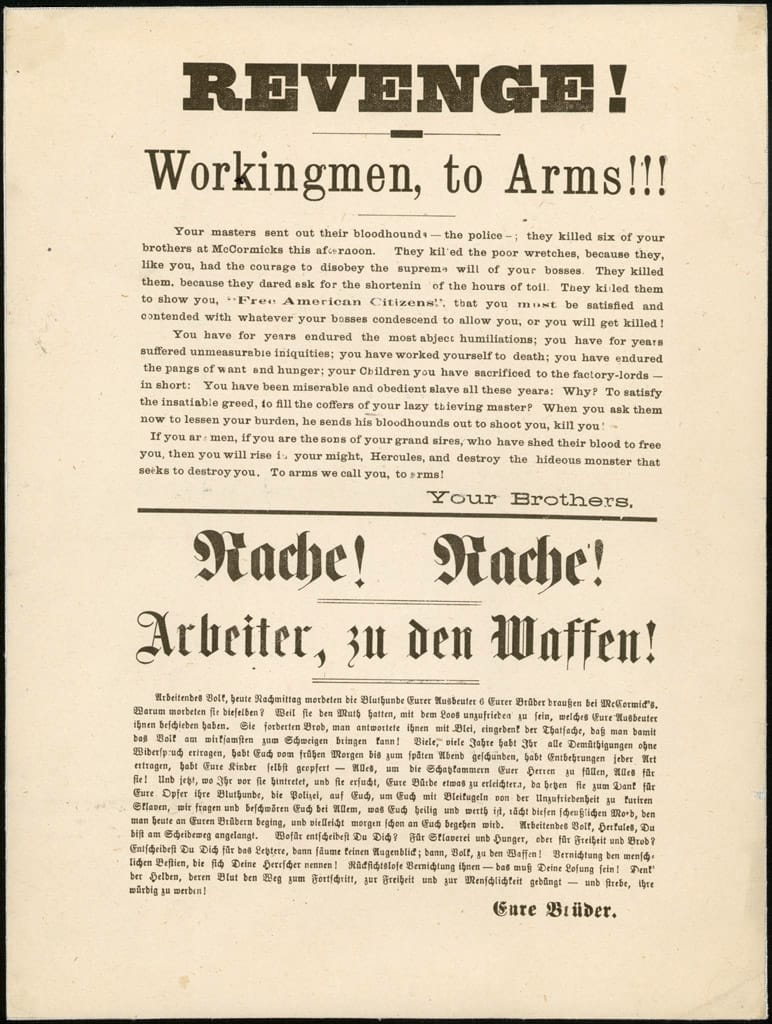
Shaken and enraged, Spies returned to his office to print thousands of leaflets calling on workers for a protest meeting the next day at Haymarket Square. The anarchist newspaper put out emergency leaflets and a call to action in both German and English:
“They killed the poor wretches because they, like you, had the courage to disobey the supreme will of your bosses. They killed them to show you ‘Free American Citizens’ that you must be satisfied with whatever your bosses condescend to allow you, or you will get killed. If you are men, if you are the sons of your grand sires, who have shed their blood to free you, then you will rise in your might, Hercules, and destroy the hideous monster that seeks to destroy you. To arms we call you, to arms.”
May 4th: The Haymarket Meeting
On May 4th, a crowd gathered at Haymarket Square. Estimates ranged from 600 to 3,000 people. The meeting was peaceful. Speakers included anarchists August Spies, Albert Parsons, and Reverend Samuel Fielden.
Chicago’s mayor Carter Harrison attended and concluded that “nothing looked likely to happen to require police interference.” He advised the notoriously violent police captain John Bonfield of this and suggested that the large force of police reservists waiting at the station house be sent home.
As the evening wore on and rain fell, the crowd dwindled. By the time Fielden was finishing his speech, only a few hundred remained. Then, at around 10:30 PM, approximately 180 police officers, led by Captain Bonfield, marched into the square and ordered the crowd to disperse. Fielden contested: “We are peaceable.”
Moments later, a bomb was thrown into the ranks of the police, instantly killing one officer. What followed was brutal chaos. Police opened fire into the crowd. Witnesses maintained that immediately after the bomb blast, there was an exchange of gunfire between police and demonstrators, though it remains unclear who fired first. However, many accounts, including historian Paul Avrich’s, conclude that police opened fire into the crowd, reloaded, and fired again, killing at least four people and wounding dozens more.
An anonymous police official later admitted to the Chicago Tribune:
“A very large number of the police were wounded by each other's revolvers. ... It was every man for himself, and while some got two or three squares away, the rest emptied their revolvers, mainly into each other.”
At least 60 officers were injured and eight were killed, some evidence suggests many by friendly fire, though it is believed that the crowd returned fire as well. The official death toll listed four workers killed, but the real number was almost certainly higher. Many wounded civilians avoided seeking medical attention out of fear of arrest, finding aid where they could or not at all.
Repression and the Trial
In the aftermath, Chicago was placed under what amounted to a state of siege. Meeting halls, union offices, printing presses, and homes were raided. Known anarchists and socialists were rounded up. Hundreds were arrested, with reports of severe abuse and coercive interrogation, many without a connection to the events at Haymarket or even to anarchism at all.
State’s Attorney Julius Grinnell openly declared:
“Make the raids first and look up the law afterwards.”
The headlines that followed revealed the beginning of the “Red scare” campaign in the US. The Chicago Tribune asked for the hanging of the strike leaders in public view.
Eight anarchists, which included prominent speakers and writers, were ultimately charged, not with throwing the bomb, but with conspiracy.They were:
- August Spies
- Albert Parsons
- Samuel Fielden
- Adolph Fischer
- George Engel
- Michael Schwab
- Louis Lingg
- Oscar Neebe
The trial, which was widely recognized as unjust, opened on June 21st 1886 in the criminal court of Cooke County. The partisan Judge Joseph E. Gary conducted the trial, and all 12 jurors acknowledged prejudice against the defendants. At the time, jurors were typically chosen by names being drawn randomly from a box. For this trial, the state’s attorney nominated a special bailiff who was appointed by the court to select the candidates. The defense was not allowed to present evidence that the special bailiff had publicly claimed: “I am managing this case and I know what I am about. These fellows are going to be hanged as certain as death”.
The jury that was intentionally selected consisted largely of businessmen and their associates, along with a relative of one of the dead police officers.
No evidence was presented that any of the defendants had thrown the bomb or conspired to do so. In fact, not all of the defendants had even been present when the bomb exploded at Haymarket Square. With this in mind, the prosecutors focused on their writings and speeches, even though Mayor Harrison himself described the speeches as “tame.” Parsons had even brought his two young children to the meeting in question, and still the prosecution made its position clear.
In his closing argument, Grinnell declared:
“Law is on trial. Anarchy is on trial… convict these men, make examples of them, hang them and you save our institutions, our society.”
On August 19th, seven were sentenced to death. Neebe received fifteen years in prison.
This was not a trial about an act, it was a trial about an ideology.
At least 114 of 136 exhibits presented at the subsequent trial were taken from the various publications the defendants were involved with.
Execution and Aftermath
Lucy Parsons, a Mexican and possibly African anarchist organizer, and one of the most powerful revolutionary voices of her era, refused to let the state write the ending. She traveled across the country organizing, speaking, and demanding that the condemned be spared. Long after Haymarket, she would go on to help found the Industrial Workers of the World (IWW), continuing her fight for militant, worker-led struggle.
Even as the state closed in, the condemned continued to speak. In a letter from his cell, waiting to be hanged, Parsons wrote:
“And now to all I say: Falter not. Lay bare the inequities of capitalism; expose the slavery of law; proclaim the tyranny of government; denounce the greed, cruelty, abominations of the privileged class who riot and revel on the labor of their wage-slaves. Farewell”
After international protests and mass campaigns for their release, the death sentences of Fielden and Schwab were commuted to life in prison.
The day before Louis Lingg was set to be hanged, Lingg committed suicide in his cell, denying the State its execution.
On November 11th, 1887, Spies, Parsons, Engel, and Fischer were hanged.
Their deaths sparked massive outrage. Hundreds of thousands lined the streets for their funeral procession in Chicago. Protests erupted around the globe. The Haymarket case became an international symbol of state repression and class struggle. Figures like Emma Goldman cited it as central to their political awakening. She later described the Haymarket affair as “the events that had inspired my spiritual birth and growth.”
Six years later, Illinois Governor John Altgeld reviewed the case and issued pardons for the surviving defendants, condemning the trial as a product of “hysteria, packed juries, and a biased judge.”
The state had made martyrs, and in doing so, it transformed a local struggle into a global one.
Who Threw the Bomb?
The question has never been definitively answered, and the prosecution never needed it to be. The goal was broader: to destroy a political current that threatened the existing order.
In the years that followed, evidence and testimony raised serious questions about the origins of the bombing. Evidence later came to light that the bomb may have been thrown by a police agent working for Captain Bonfield as part of a conspiracy involving certain steel bosses to discredit the labour movement, but there was no definitive proof.
Workers at the time understood that the forces aligned against them were willing to manufacture crises to justify repression. Private security firms like the Pinkerton Detective Agency were deeply embedded in labor struggles, routinely hired to infiltrate unions, gather intelligence, and disrupt organizing, often through violence.
Albert Parsons himself argued: "The charge made by the labor papers that the monopolists were at the bottom of the Haymarket tragedy, and that the Pinkertons were employed to carry it out, supplies the key to the solution of the mystery as to who did throw that bomb."
While others within the movement rejected this theory and were confident an angry worker was responsible for the bomb, the suspicion itself reflected a broader reality: workers understood that the forces aligned against them were willing to manufacture crises to justify repression.
The Voices of the Condemned
The defendants understood exactly what was happening to them. They were not being punished for an act. They were being made into a warning.
After being sentenced to die, August Spies declared:
"If you think that by hanging us you can stamp out the labour movement... the movement from which the downtrodden millions, the millions who toil in misery and want, expect salvation — if this is your opinion, then hang us! Here you will tread on a spark, but there and there, behind you — and in front of you, and everywhere, flames blaze up. It is a subterranean fire. You cannot put it out."
His final words:
"The day will come when our silence will be more powerful than the voices you are throttling today."
And Louis Lingg, defiant to the end:
"I die happy on the gallows… so confident am I that the hundreds and thousands to whom I have spoken will remember my words… I despise your order, your laws, your force-propped authority. Hang me for it!"
They were not pleading for mercy. They were documenting repression and predicting what would come next.
From Martyrs to Holiday and Erasure
In 1889, May 1st was declared a global workers' holiday in honor of the Chicago struggle. But in the retelling, something was lost.
The official narratives that followed stripped out the anarchists who made Haymarket possible. The event was remembered, but its political edge was dulled. The martyrs were acknowledged, but their ideas were sidelined or omitted entirely. Their militancy was softened. This wasn't accidental.
By the late 19th century, anarchists had already been pushed out of many socialist organizations. Their role in mass movements, especially militant ones, was increasingly downplayed in favor of more controlled, institutional narratives. Even later historical accounts of May Day frequently erased anarchism altogether, reducing the holiday to a generalized labor commemoration rather than what it actually was: a direct product of anarchist-led struggle and state repression.
The result is the version of May Day most people encounter today, detached from its origins, stripped of its antagonism, made easier to absorb.
When history is sanitized, its lessons disappear with it.
The Template That Remains
The Haymarket trial helped establish a framework that has been repeated for more than a century. Movements are defined as threats. Media narratives amplify fear. Individuals are collapsed into conspiracies. Beliefs and associations become evidence. The goal is not simply conviction, it is disruption. That framework is still in use.
In recent federal prosecutions tied to protests, including the Prairieland 19 case, prosecutors have advanced sweeping conspiracy theories that extend far beyond individual actions. Defendants who were not present at alleged acts of violence have still faced serious charges, with the government arguing that association, shared political identity, or proximity is enough to establish culpability. As in Haymarket, the focus shifts away from what any one person did and toward what a group represents.
The language has changed, but the structure has not. Where anarchists were once labeled foreign agitators, movements today are framed as extremist or terror-linked. Journalists still get blamed for inciting violence. Digital communication, group chats, social media, encrypted messaging, and even literature are introduced as evidence of conspiracy.
Surveillance has expanded accordingly. Law enforcement agencies increasingly rely on digital monitoring, facial recognition, and data aggregation to map networks of activists. The technology may be new, but the intent is not.
A Living Tradition
For anarchists especially, May Day remains a day of remembrance: a day when the state put anarchism itself on trial; when the limits of "free speech" were violently enforced; when the relationship between capital and state power was exposed without apology.
It is also a living tradition, connected to ongoing struggles, from labor organizing to migrant justice movements. The Haymarket martyrs believed they would be remembered. They were right. Their execution did not end the movement. It helped define it.
Authorities believed the repression would crush the eight-hour struggle. Instead, it exposed the willingness of the state to criminalize dissent itself, and in doing so, gave that dissent a date, a name, and a reason to endure.
May Day was never just about labor reforms. The eight-hour demand was part of a broader challenge to wage labor and class domination. It was not a polite negotiation. It was a confrontation. And Haymarket made one thing clear above all: the state was willing to execute people not for what they did, but for what they believed, and the movements they helped build.
Every May Day is a return to that moment. Not as nostalgia, but as a reminder of struggle, repression, and resistance. A reminder that the forces they tried to destroy did not disappear.
They adapted. They spread.
And they are still here.
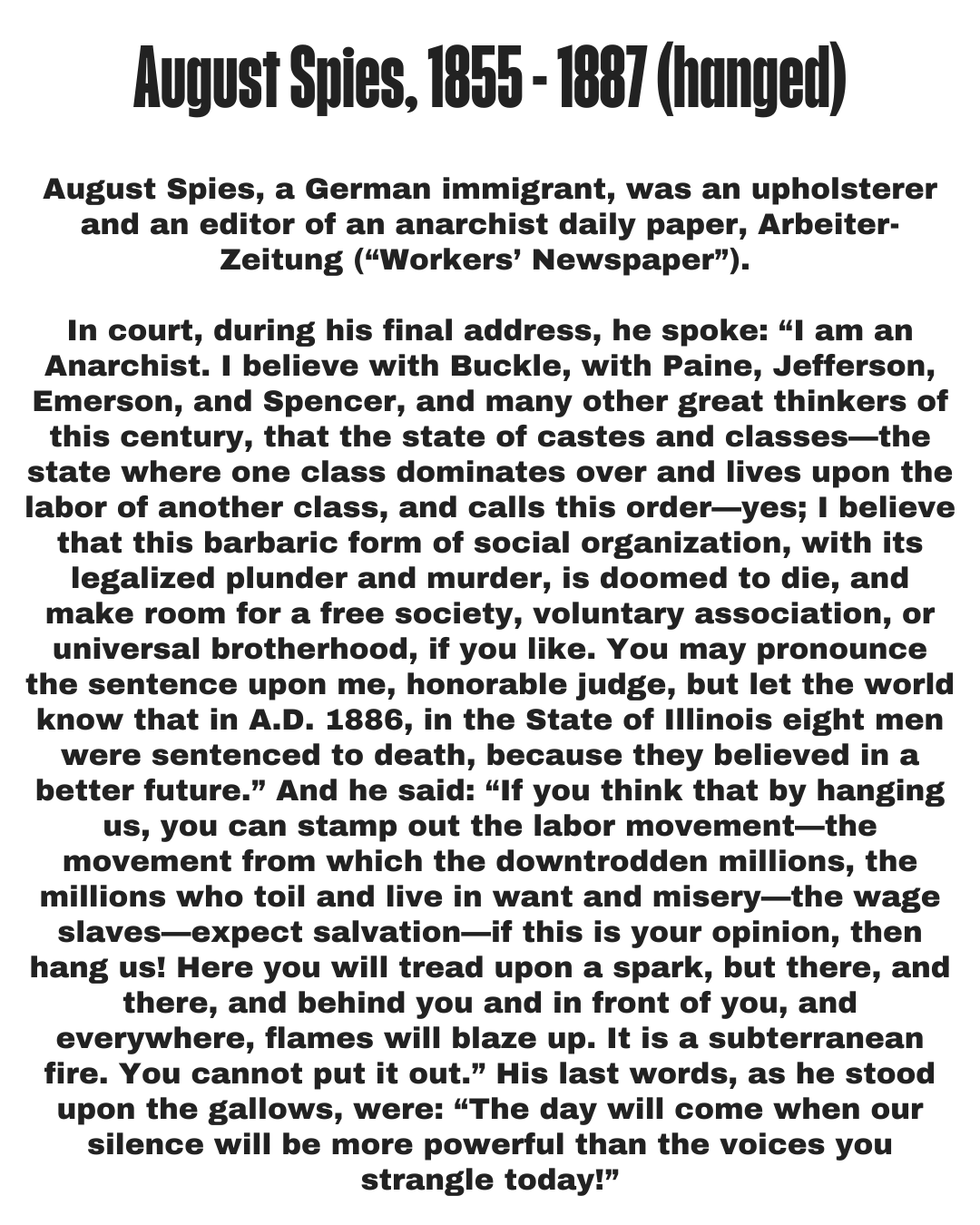
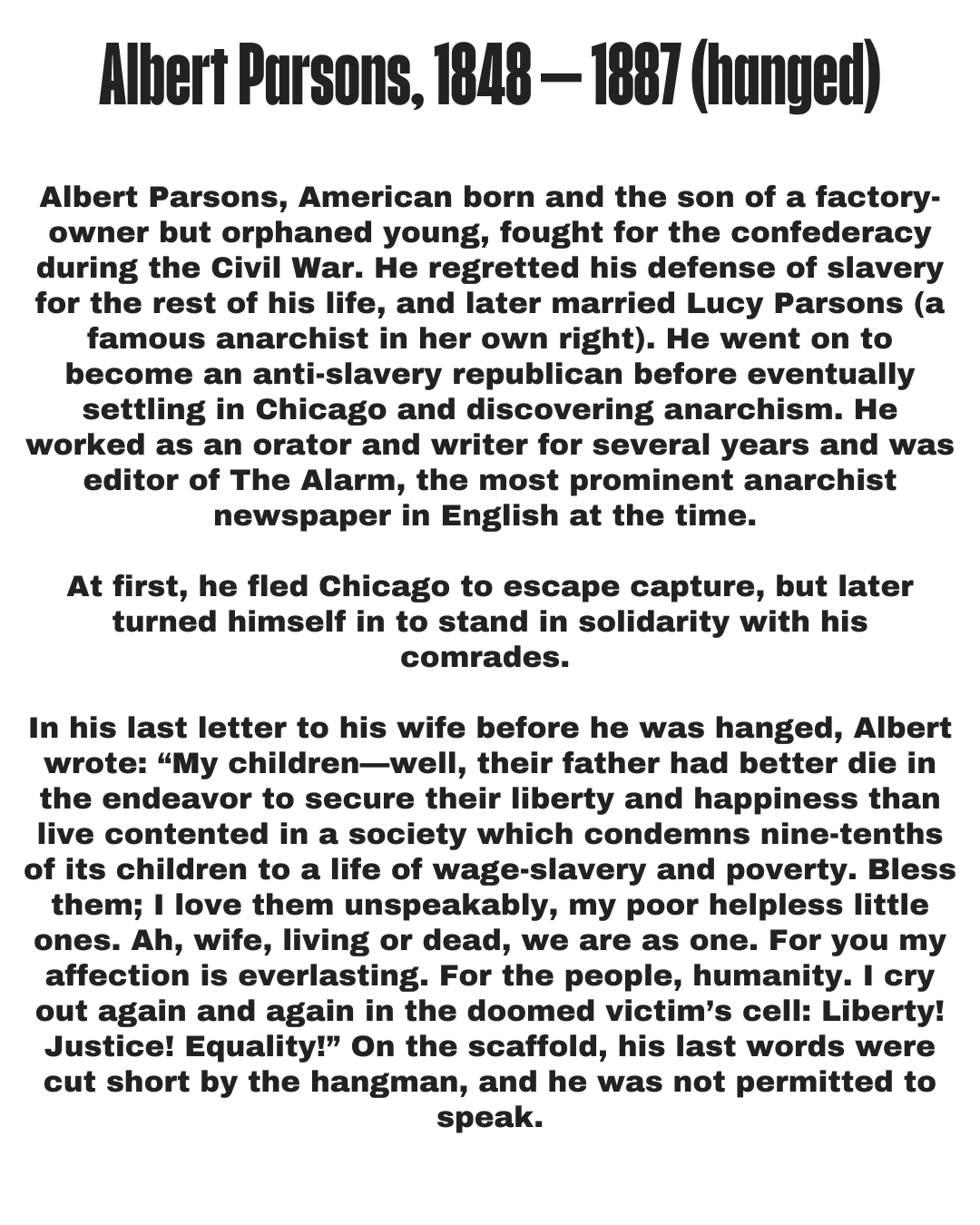
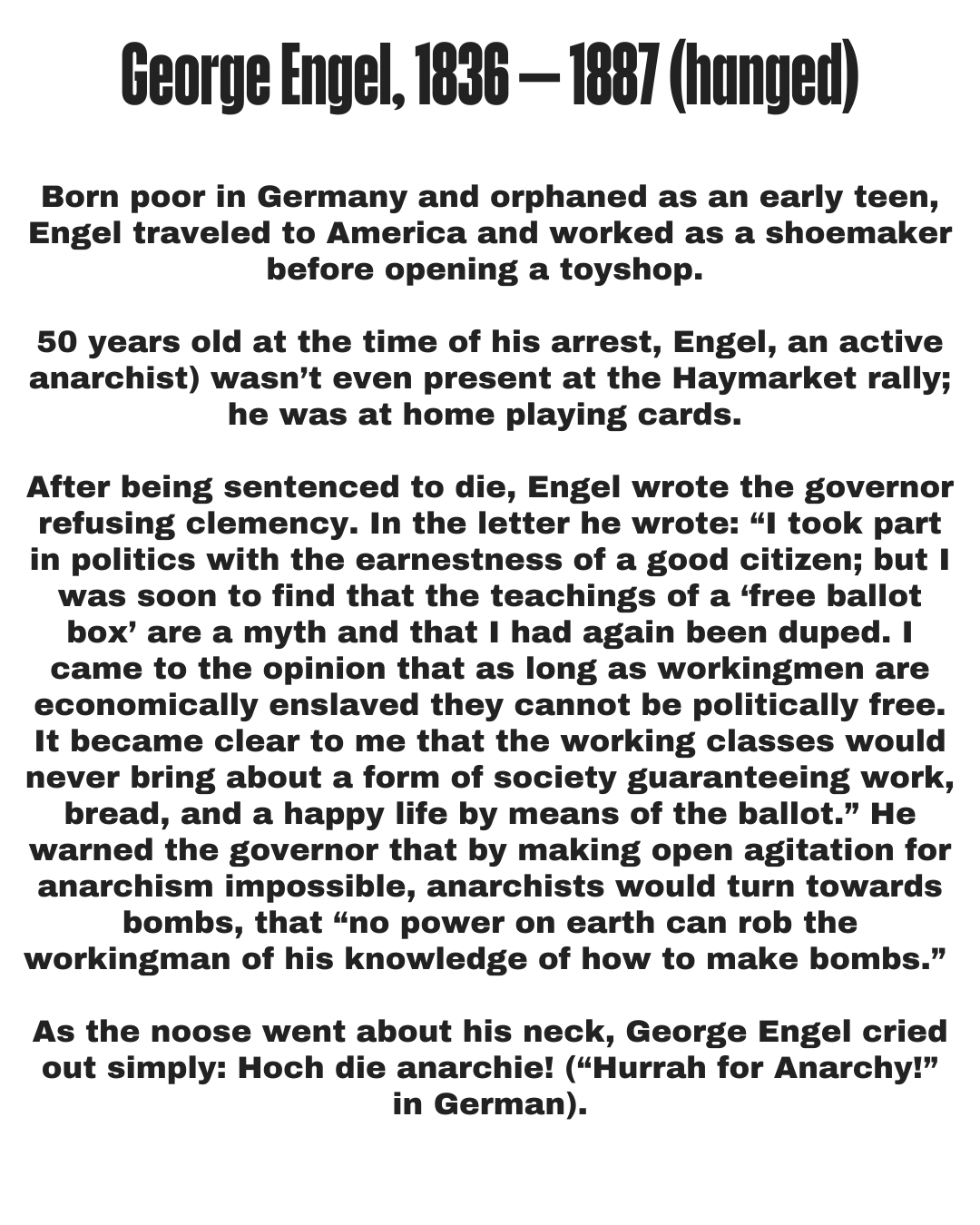
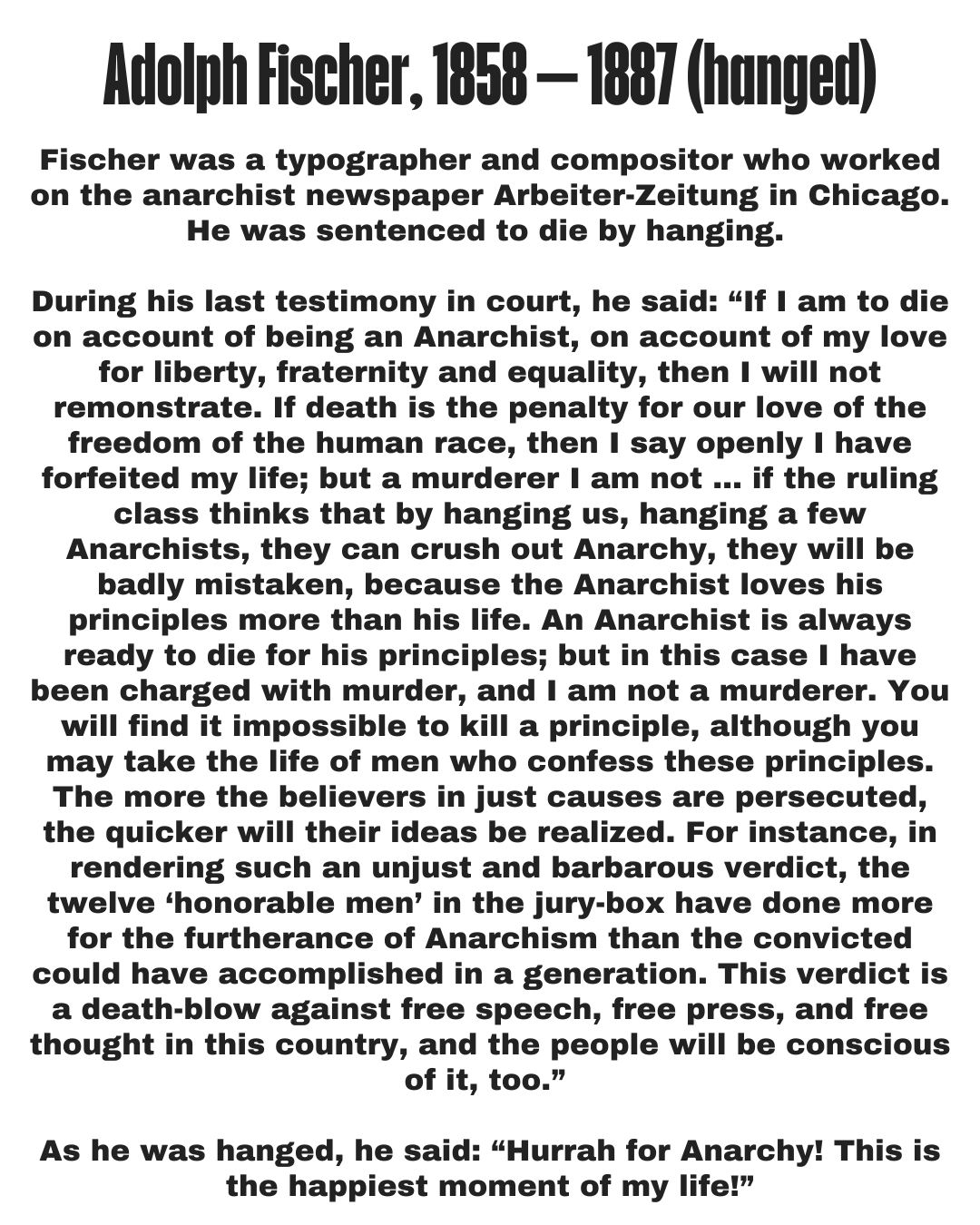
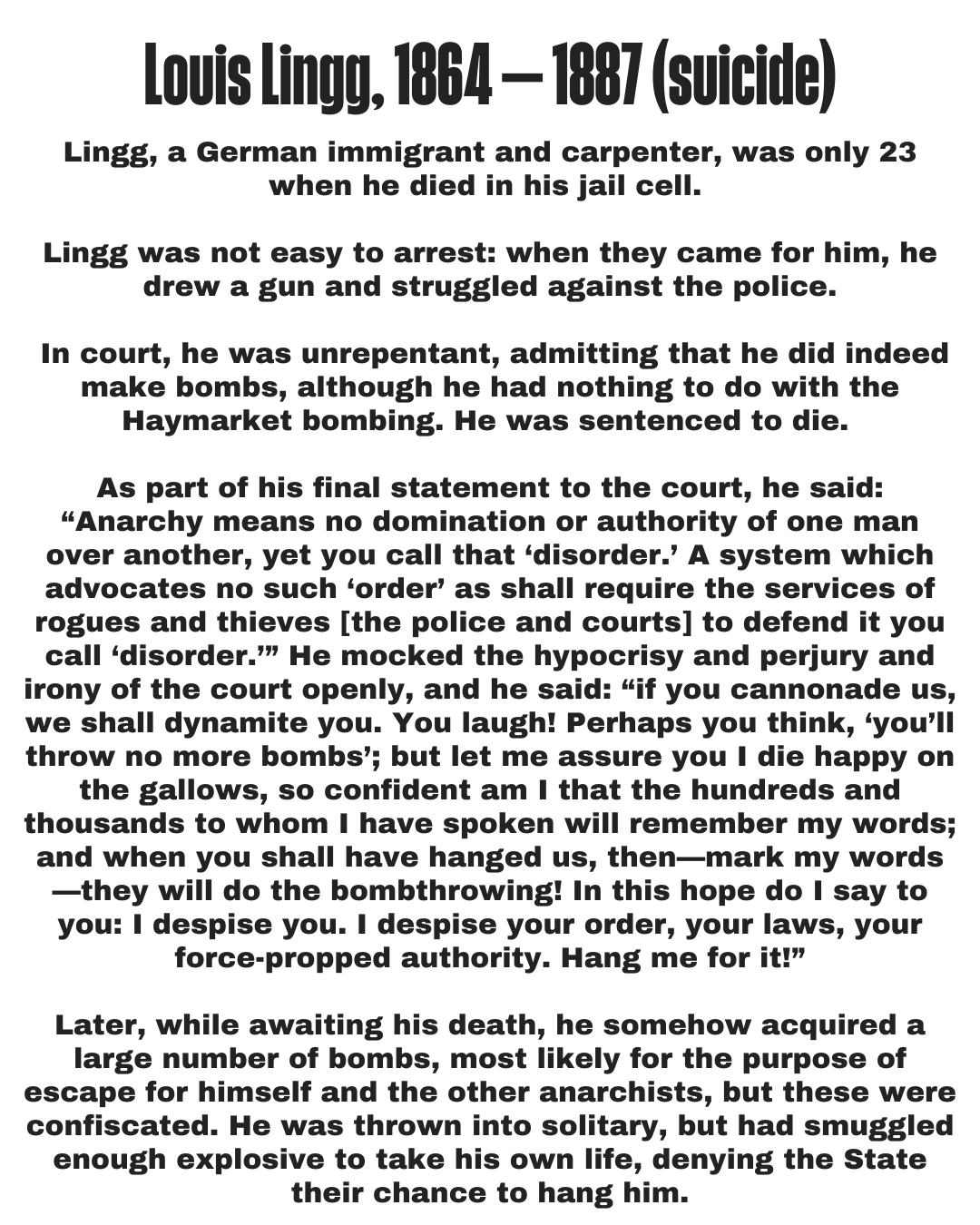
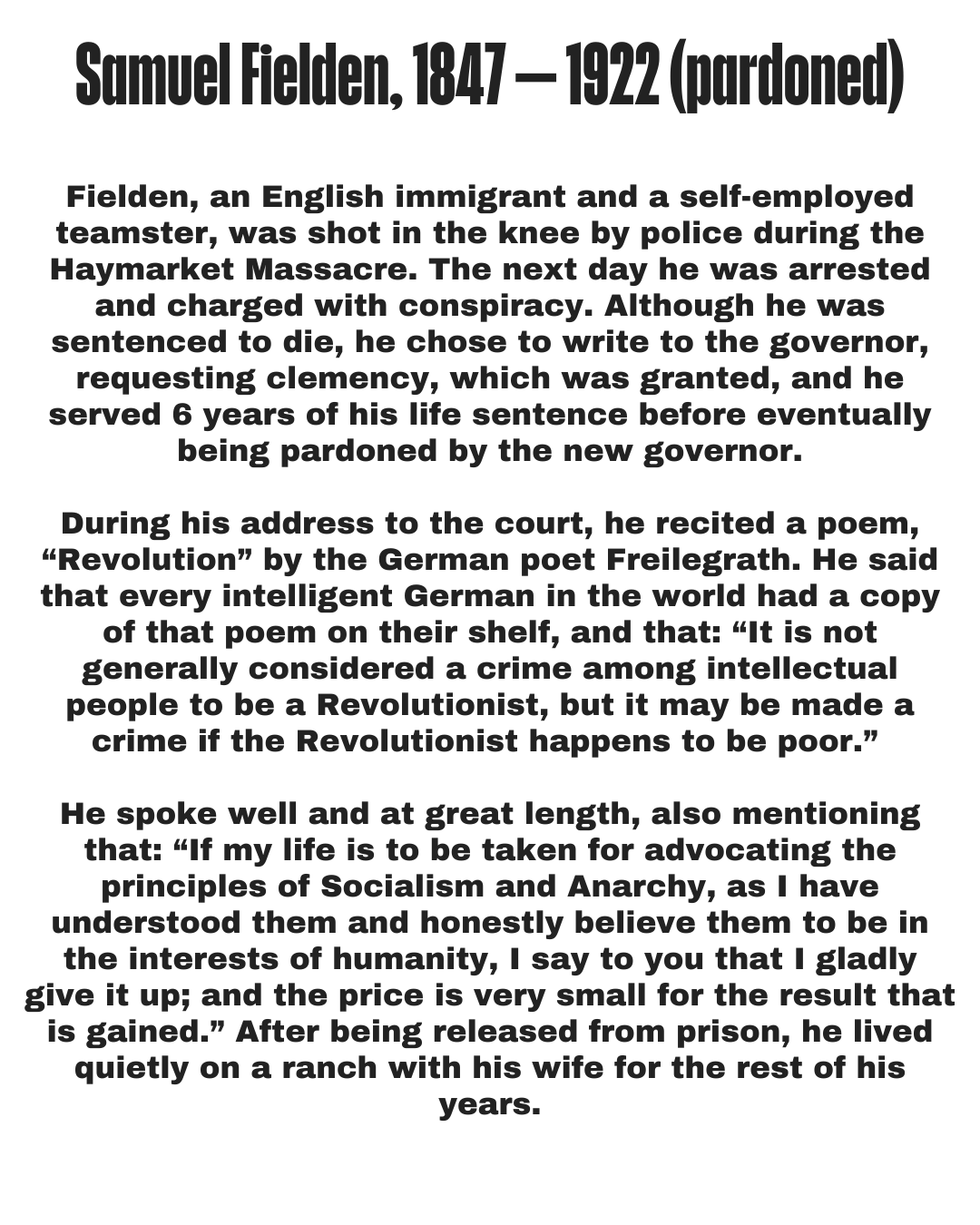
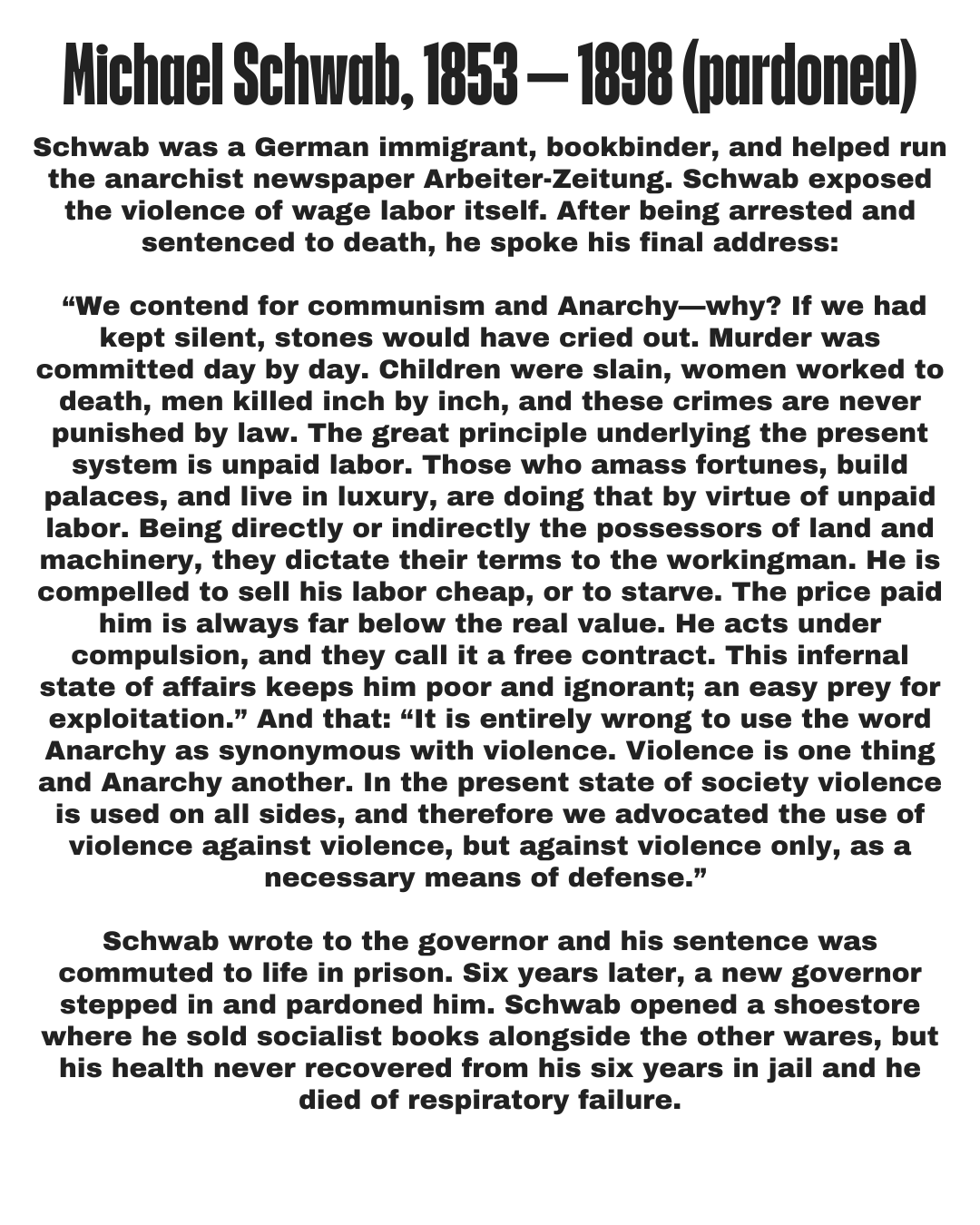
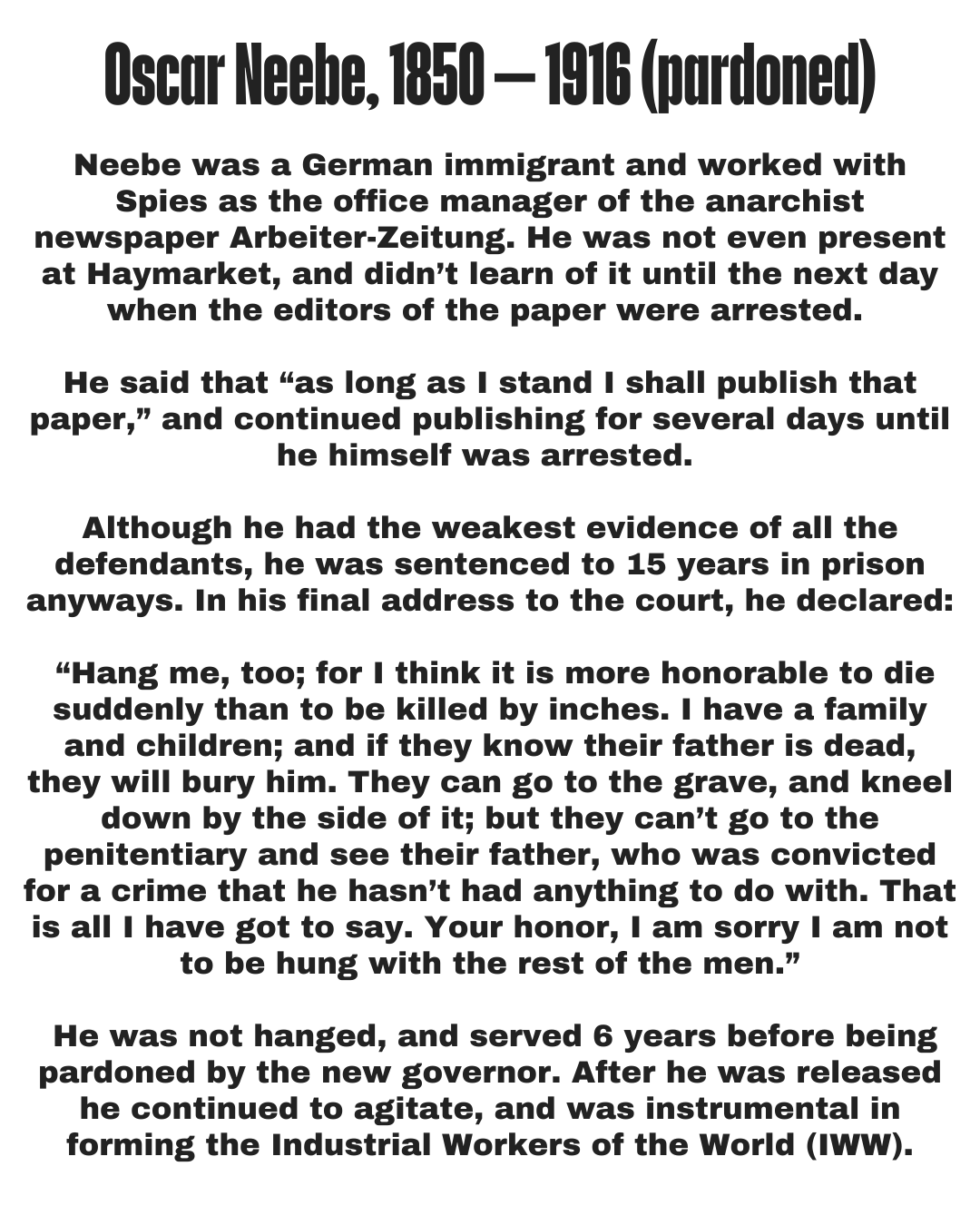
The Defendants, from “Hurrah for Anarchy” by Strangers in a Tangled Wilderness
Citations and more reading:
 Strangers In A Tangled Wilderness
Illinois Labor History Society
Paul Avrich, The Haymarket Tragedy (1984)
James Green — Death in the Haymarket
Chicago Tribune archives (1886–1887 coverage)
Illinois Governor John Peter Altgeld pardon statement (1893)