Prairieland Part 4: Blueprint for Repression
Prairieland marks a dangerous precedent. When speech, political association, encrypted chats, legal gun ownership, and proximity to protest become grounds for decades in prison, dissent itself becomes criminalized.

Eight defendants in the federal Prairieland case were sentenced today to prison terms ranging from 30 to 100 years, marking one of the most severe punishments imposed on anti-fascist and anti-ICE activists in recent memory and signaling a dramatic escalation in the federal government’s campaign to recast political dissent as terrorism.
Three months after a jury returned sweeping convictions against nine defendants, U.S. District Judges Mark Pittman and Reed O’Connor imposed sentences that supporters, legal observers, and family members described as cruel, retaliatory, and wildly disproportionate to the conduct at issue. Benjamin “Champagne” Song received a 100-year sentence. Maricela Rueda received 70 years. Savanna Batten, Zachary Evetts, Autumn Hill, Meagan Morris, and Elizabeth Soto each received 50 years. Daniel Rolando Sanchez Estrada, who was not present at the July 4 protest and was convicted largely over allegations that he moved zines after arrests were made, received 30 years. Ines Soto is scheduled to be sentenced July 1.
The sentences stem from a July 4, 2025 noise demonstration outside the Prairieland ICE Detention Center in Alvarado, Texas, where protesters gathered to set off fireworks in solidarity with detainees held inside. After property damage occurred near the facility and Alvarado police arrived on scene, Lt. Thomas Gross was allegedly struck by gunfire after Song fired from nearby woods. Only Song was accused and convicted of firing a weapon, yet federal prosecutors successfully argued that nearly everyone present shared criminal liability through conspiracy and material-support theories that transformed association into culpability and proximity into participation.
That prosecutorial theory has defined the Prairieland case from the beginning and remains one of its most alarming features. The government repeatedly relied on encrypted Signal chats, anti-fascist literature, zines, shared reading groups, black bloc clothing, and legal firearm ownership as evidence of an extremist conspiracy, despite longstanding constitutional protections for speech, association, privacy, and political organizing. Several defendants were not involved in planning the demonstration, some weren’t even there, and many of the protesters didn’t even know each other. Defense attorneys repeatedly argued that prosecutors failed to establish evidence of a concrete illegal conspiracy, instead constructing one through ideology, aesthetics, and guilt by association.
Those concerns now feel impossible to separate from the sentences themselves. When decades in prison can be imposed not only on the individual who fired a weapon but also on people whose alleged involvement centered on attendance, association, logistics, or possession of political literature, the implications extend far beyond this single case. The question raised by Prairieland is no longer merely whether prosecutors stretched conspiracy law too far, but whether meaningful democratic participation can survive a legal framework in which protected political activity can be reframed as evidence of terrorism.
This is an attack on everyone who opposes ICE's ethnic cleansing agenda. If the judge could have sentenced protesters to death, he would have.
— Firestorm Books (@firestorm.coop) June 23, 2026 at 9:05 AM
Champagne (Benjamin Song) addressed that reality directly in a statement following sentencing, rejecting the logic underpinning the prosecution and calling the outcome what many supporters have argued all along: collective punishment.
Now, 22 people have been arrested, have been persecuted, have been tortured, for what?
For nothing.
None of these people really did anything.
And none of these people have anything to do with what happened with me.
This is wrong. This is mass punishment. This is collective punishment. This is guilt by association. This is injustice.
Underlying much of that collective punishment is the expansive use of conspiracy liability, particularly the logic established in Pinkerton v. United States, a doctrine that allows defendants to be held criminally responsible for the foreseeable actions of alleged co-conspirators even when they neither directly participated in nor intended those acts. Long criticized by legal scholars for enabling guilt by association, the doctrine took on extraordinary force in Prairieland, where prosecutors used conspiracy allegations to bridge vast gaps between individual conduct and collective punishment. In practice, this meant that defendants who neither fired a weapon nor, in some cases, participated in planning the demonstration could still face decades in prison for acts carried out by others. Prairieland illustrates how conspiracy law, when paired with terrorism rhetoric, can collapse the distinction between individual culpability and political association, dramatically expanding the state’s power to punish groups rather than acts.
That framing is difficult to ignore. The Prairieland prosecution has, from indictment through sentencing, tested how far the government can expand conspiracy and terrorism-adjacent legal theories to impose collective liability on loosely connected activists. In practice, it has advanced a model in which political affinity itself becomes evidentiary glue.
The severity of today's sentences underscores just how extraordinary that model has become. Several of the punishments handed down in Prairieland exceed those imposed in some of the country’s most widely publicized political violence prosecutions, including January 6 cases involving leaders of organized far-right groups convicted of seditious conspiracy. Enrique Tarrio, former leader of the Proud Boys, received 22 years. Stewart Rhodes, founder of the Oath Keepers, received 18 years. The comparison is not perfect, but the disparity is difficult to ignore: anti-fascist defendants convicted under expansive conspiracy theories are receiving sentences measured not in years or decades alone, but in lifetimes.
Prairieland also appears increasingly less like an isolated prosecution and more like a blueprint. Just days before these sentencings, federal prosecutors in Minnesota filed conspiracy charges against 15 activists accused of interfering with ICE operations, further signaling the spread of the same prosecutorial logic used in Texas. These cases are unfolding amid a broader federal crackdown shaped in part by National Security Presidential Memorandum-7, issued by President Donald Trump after the killing of Charlie Kirk, which formally directed federal agencies to investigate and disrupt so-called antifa-linked networks under a domestic terrorism framework. Prairieland now sits at the center of that transformation.
Today, the US Attorney's Office in Minneapolis and Homeland Security Investigations announced "Antifa" charges against accused anti-ICE protesters. In short, after ICE murdered people in the streets, they want to pretend that those who stood up to ICE represent the real threat to the public. 🧵⬇️
— CrimethInc. Ex-Workers' Collective (@crimethinc.com) June 16, 2026 at 9:59 AM
[image or embed]
The goal of the "Antifa" charges is to terrorize people out of standing up for each other when federal agents descend on a community to do violence to it. We must stand by one another. The 15 people charged are alleged to be participants in Black Cat Workers Collective and Direct Action Minnesota.
— CrimethInc. Ex-Workers' Collective (@crimethinc.com) June 16, 2026 at 9:59 AM
[image or embed]
Having failed to overcome the united community response to Operation Metro Surge, Trump's toadies are now attempting to divide and conquer—purporting to support the right to protest while targeting "Antifa" protesters. Make no mistake, this is directed at all who do not welcome authoritarianism.
— CrimethInc. Ex-Workers' Collective (@crimethinc.com) June 16, 2026 at 9:59 AM
[image or embed]
All nine trial defendants filed motions for a new trial, arguing that the proceedings were saturated with political bias, inflammatory rhetoric, and constitutional violations, including the admission of speech and association evidence that should never have served as proxies for criminal intent. Judge Pittman dismissed multiple motions to overturn the convictions without written rulings and with little explanation.
Outside the courthouse, supporters vowed to continue fighting through appeals, but the broader warning of Prairieland is already clear. If prosecutors can secure terrorism-linked convictions and extraordinary prison terms by treating literature as evidence, encrypted communications as proof of criminal intent, ideology as conspiracy, and association as liability, then the constitutional protections underpinning speech, assembly, dissent, and political organizing become increasingly hollow. A democratic society cannot meaningfully function when participation in protest carries the risk of generational punishment untethered from individualized culpability. What happened in Prairieland is therefore not only about eight defendants sentenced in Texas; it is about the rapidly expanding power of the state to redefine dissent itself as terror.
The judge said, “the state wants to send a message to anyone who shares a similar ideology.” The message is clear: dissent against the fascist state will be treated as terrorism.
For Parts 1-3:
 Sabr Qalam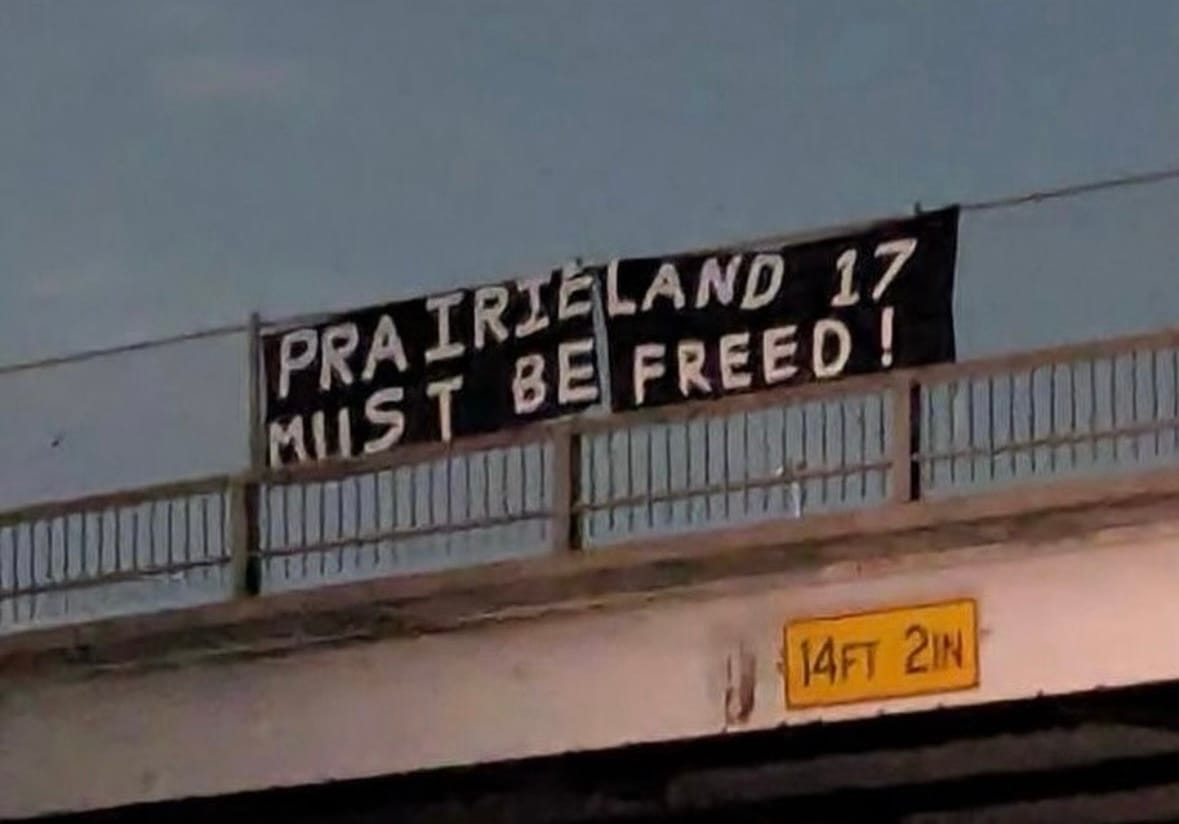
 Sabr Qalam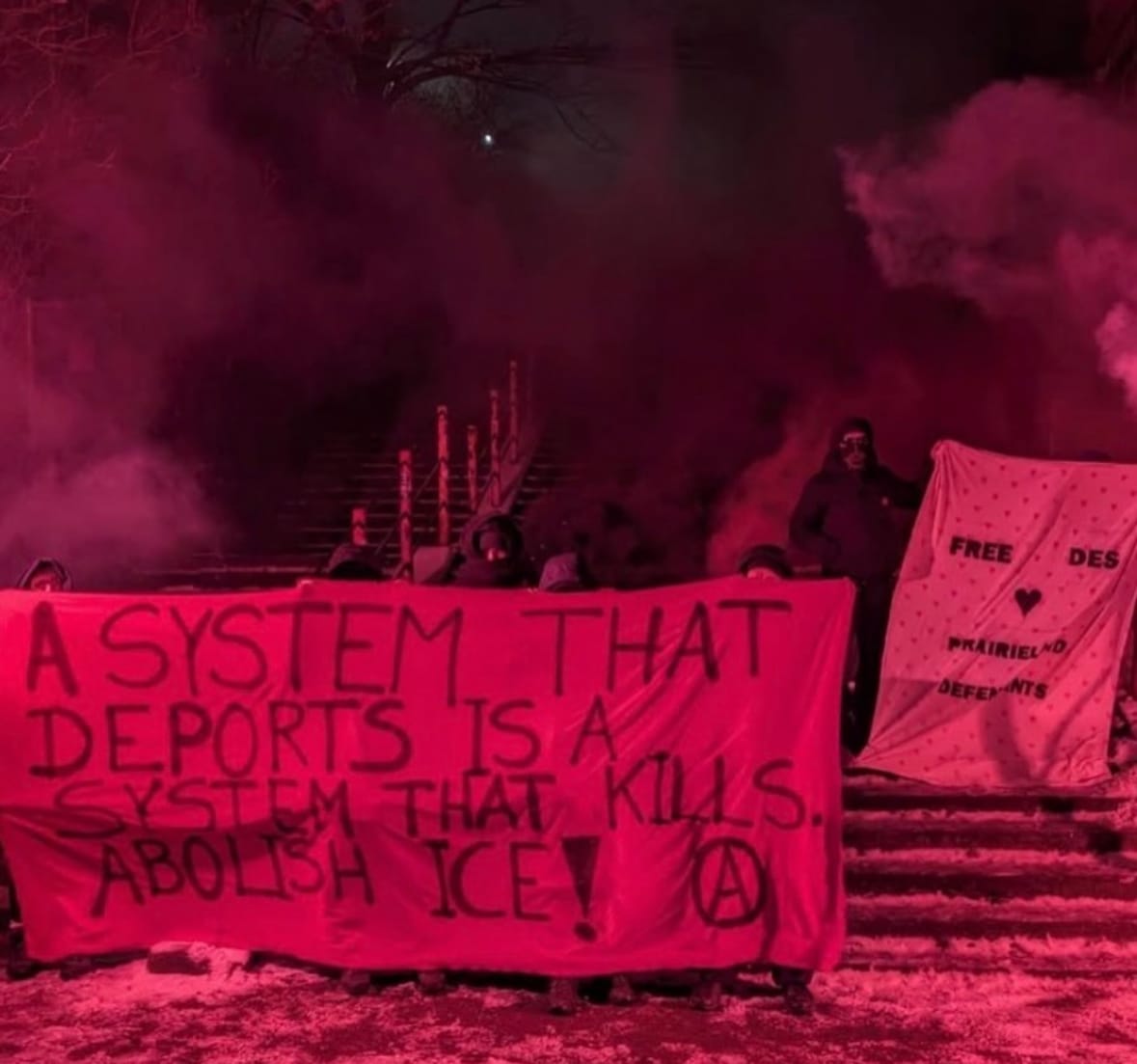
 Alissa Azar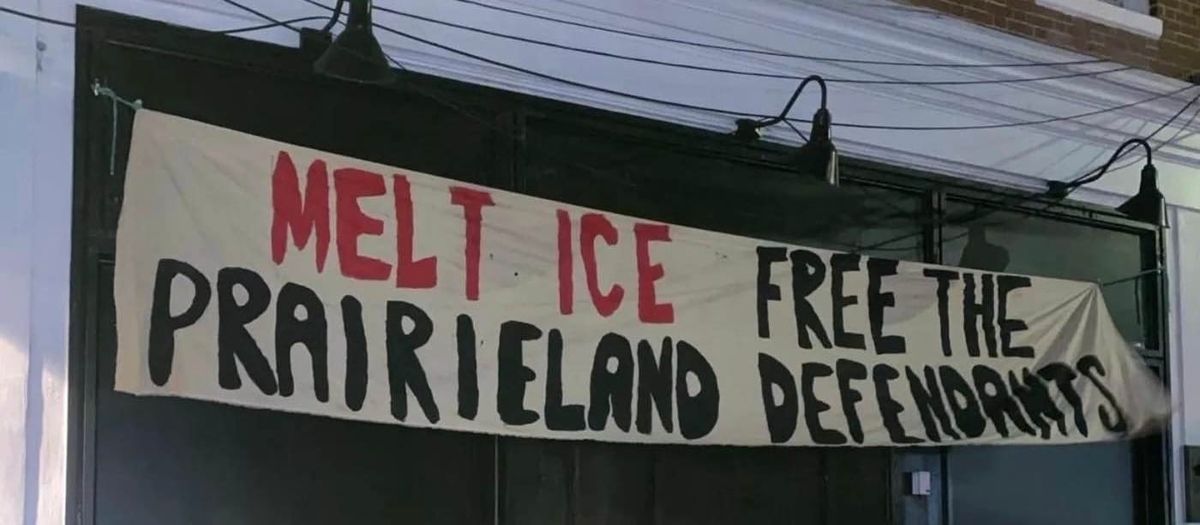
Recommended Reading:
 prairieland
 prairieland