Suspension and Selective Discipline at Lewis & Clark against Pro-Palestine Activism
On October 6, 2025, a memorial installed by a campus Hillel chapter at Lewis & Clark in Portland, Oregon drew significant emotional responses from students. The display featured photos of Israeli hostages and a sign describing the October 7 attacks, using language students described as misleading. Students described this organization as “proudly Zionist.” Previously, similar displays had sparked student outrage but had not resulted in major disciplinary outcomes.
This time was different.
Two students who challenged the display, through removal of the memorial and the posting of images honoring Palestinian martyrs, became the first undergraduates at Lewis & Clark in recent memory to be suspended for political activism. Both students were people of color. One is Arab and Muslim; the other is Black and Jewish.
Their cases offer a window into how student discipline is increasingly being used to police political speech and protest, especially when it challenges dominant institutional narratives.
Confronting the Memorial and Administrative Response
Julian, who is Black and Jewish, witnessed the memorial as it was being put up and expressed discomfort with its framing. He said it was propaganda in such a central part of campus that had a lot of foot traffic, and that the messaging was villainizing Palestinians and leaving out key information. He said the display “felt like it erased everything happening in Gaza,” and described feeling unsafe in spaces on campus dominated by pro-Zionist messaging.
"I was eventually planning on talking to people that were putting these signs up, and asking them if they were planning on adding any information about Palestinians and what happened… this genocide is happening to Palestinians. They are the ones who were getting bombarded right now.
I went over there. No one was there, but the signs were out. So I walked over to the signs.
I took a look at that sign and I just got so upset after reading it. It personally upset me as a Jewish student myself. Not once did they offer any kind of resource or support for people who were affected by anti-semitism, which is not solely just Jewish people.
The term antisemitism is structured towards people who speak Semitic languages, Semitic areas, which includes Palestinians and so many different types of people that they don't want to acknowledge. They were only using this to describe Jewish people, or namely, white Jewish people in Israel. I can't really describe many of the feelings that came up at that time due to how upset I was, but it just was complete misinformation.
I got incredibly upset and started taking the posts out of the ground. I took them out one by one. I made an effort to place them back on the ground when I was done."
As he was removing the wooden stakes from the ground, someone approached Julian and began recording him as they were shouting. He responded to the shouting by asking what the person recording was going to do about the 500,000+ murdered Palestinians, to which she responded by mocking Julian and laughing. At that point, more students from Hillel approached until Julian was surround by around 7 people. Julian recalled how all the Hillel students surrounding him were white, a fact he at one point called them out for, and a comment he was later reprimanded for making by the college.
Aseel, the Arab Muslim student who was a freshman at the time, also found the memorial upsetting and, after learning another student had already taken it down once, removed some of the stakes with photos again later that night.
The next morning, she returned to place images of Palestinian martyrs, actions later confirmed on security footage as involving no property damage.
"I put photos of Palestine martyrs everywhere,” she said.
According to Aseel, Hilary Martin Himan, the university’s Director of Spiritual Life, approached her afterward. Aseel says Himan had not witnessed the removal but approached her after noticing she was wearing a keffiyeh and attempted to initiate a conversation. When Aseel declined, Himan allegedly sat down anyway and began explaining Israel, Palestine, and the two-state solution.
At that point, Aseel describes responding in frustration:
“I told her I already knew about Israel and Palestine. I’m Arab. I’m Muslim. I live this every day of my life.”
The exchange escalated. At one point, Aseel alleges the administrator called her a “colonizer” after she referred to Israel as a “colonial project.”
Shortly after, Dr. Benjamin Meoz, Vice President for Student Life and Dean of Students, joined the interaction, according to Aseel.
She recalls that after she defended herself, the Director of Spiritual Life exclaimed:
“Fine. I am racist. I claim it.”
Himan and Dr. Meoz continued to push back, Aseel says:
“They kept framing it as them trying to have a conversation with me, except they just kept trying to explain the genocide over and over again. And at some point I thought, yeah, I really don’t want to do this. Eventually, the dean of students threatened to kick me off campus if I didn’t identify myself, so I left."
Aseel says it was Himan who later reported her for posting the images of Palestinians.
No physical confrontation occurred. No arrests were made. The student left voluntarily.
Weeks later, the disciplinary charges arrived.
By mid-October, she received a report alleging property damage, disorderly conduct, and harassment. The property damage charge was later dropped after review of footage, but other allegations remained.
Aseel was also issued a no-contact order by another student who, according to multiple peers, has a history of filing complaints against pro-Palestinian activists.
Julian, who also received a no contact order, was also found guilty of four charges: disorderly conduct, property damage, harassment and hate -or bias- motivated conduct, and violent, abusive, or threatening conduct. The last three charges stemming from calling the students “white.” It is still unclear why Aseel’s property damage charges were dropped but Julian was found guilty, even though they both did the same thing with the memorial.
The “November 10 Incident” and Disciplinary Escalation
A separate incident on November 10, described in administrative letters as disruptive conduct, involved Aseel sitting in a dorm lounge with friends while that same student group responsible for the October 6 memorial hosted an “Israeli cookout” on the other side of the room.
Aseel and her group of friends had planned to watch Mean Girls, but because of the volume from the event, which they say they had not known about prior to arriving, they opted to chat until it ended.
At one point, while talking quietly with friends, one of the students played the Palestinian song Dami Falastini on their phone. According to Aseel, organizers responded by turning their own music louder.
There was no confrontation.
“Did we laugh to ourselves a little? Sure. It was an ‘Israeli cookout’ but they had West Asian and North African food. But there were never any kind of threats or even confrontations.”
Only one person received a disciplinary notice the following day: Aseel.
White students present received no warning, no charge, and no follow-up.
“After they said I disrupted the organization's event, they placed an interim action plan where I couldn't contact any of the members. To me, this wasn’t a big deal because I wasn’t planning on it, but it was still upsetting since they outlined it as ‘going there willingly, sitting down and playing a certain song to disrupt the event.’ I wanted them to be more specific, because I had my suspicions as to why they would have a problem with said certain song being played quietly. They just couldn't necessarily say it."
Dami Falastini does not reference Israel or Zionism. The title means “my blood is Palestinian,” and the song centers on personal connection to homeland.
In subsequent meetings, administrators repeatedly framed the issue as Aseel’s failure to consider Jewish students’ feelings.
"Well, did you consider how you would make Jewish students on campus feel?” she recalled administrators asking.
“Truth is, I wasn’t really considering Jewish students on campus because I don’t think that this has anything to do with Judaism or Jewish students. This was clearly a memorial for Zionist students, so I told them I would appreciate if they would stop conflating the two.”
Aseel argued that criticism of Zionism is not antisemitism and that the original memorial was a political act, one that justified a political response. Administrators disagreed, she says. They argued that protest itself was disruptive. When she replied that protest is meant to be disruptive, that statement was later cited in the suspension decision as evidence of misconduct.
"I even asked if I could put up a memorial for Palestinian martyrs next to it. They said that I theoretically could, but they wouldn’t protect it in the same manner. So if anyone were to take it down or vandalize it, it wouldn't lead to any disciplinary actions the same way taking down their memorial did. This is due to a whole process where the school makes sure they approve of the content. Not only did I not have time for that after being blindsided by this memorial the day the genocide accelerated, but this protest is one against the school’s actions as well, considering they approved the content of that memorial in the first place."
The Suspension
Just before Thanksgiving break, the university issued its ruling.
Suspension for the semester.
She was ordered to complete behavioral coursework, write a reflective letter, and issue an apology as conditions for return. Her appeal, which was supported by letters from professors and a petition signed by roughly 500 students, was denied.
She ultimately withdrew.
No white students involved in Palestine activism were suspended. No students involved in prior memorial incidents were suspended.
"None of the students involved in the encampments in 2023 and 2024 were suspended. There was a sit-in where people were threatened by faculty, but when it eventually came to the process, they were immediately told that they wouldn't be suspended for anything. There was a student going around, taking down Hillel posters, and of course, other students taking down this same memorial in the previous year. But no one was ever suspended for anything. A lot of people, as well as Julien and I, felt that it was it was no accident the first two LC students to be suspended for this sort of behavior were an Arab/North African Muslim and a Black Jewish student."
Aseel says administrators attempted to frame the Black Jewish student as “dangerous, aggressive and disruptive... and just a lot of really disgusting dog whistles.”
She added:
“…there was so much talk about ‘making Jewish students unsafe on campus,’ completely disregarding how he, as a Jewish student as well, felt unsafe with that memorial up and with Hillel on campus… He said that he felt like the entire time his identity didn't really matter because he wasn't white and Jewish."
Security footage showed no vandalism.
No physical threats were made.
No prior suspensions existed for comparable conduct.
What remained, administrators said, was her “attitude.”
“I was willing to face consequences,” Aseel said. “Just not racialized ones.”
Julian similarly received his suspension on November 19th. WWFU reviewed the suspension notice and Final Outcome documents, and interesting enough, even the college administrators in it acknowledged that in the year prior, students took similar action against the memorial - and yet, those students were never suspended.
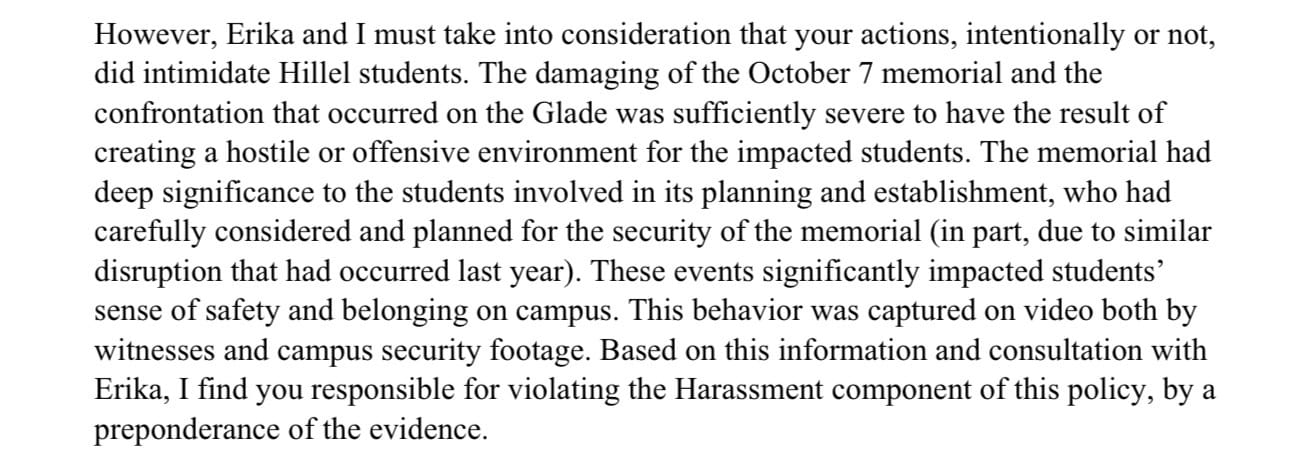
“I was painted as aggressive, even dangerous,” Julian said. “But all I did was participate in political expression and resist a display that felt oppressive. They made our identity and attitude the crime.”
Fear, Funding, and Fascism
Some students speculated that the college was reacting to national political pressure.
"I was told so many times, ‘What if they're just cracking down on students because Trump's administration is now in power and they're scared of being targeted?’ But Lewis & Clark is a small liberal arts institution. They do not heavily rely on government funding in the same way public schools do. We have more of an opportunity and an obligation to act with integrity."
"And even if there were external pressures, fear cannot justify abandoning principle. If Lewis & Clark stands on the values that they advertise, they wouldn't fold under any amount of pressure. These values are not meant to exist only when it’s convenient or safe. They’re meant to be upheld precisely when they’re tested. They should stand with their students, because Lewis & Clark is nothing without them. It's deeply disappointing to turn their back on students of color, now, when it is time to stand behind them, just to preserve a reputation that caters to a fascist administration and a genocidal regime. To reduce our actions to “poor judgment” misses the broader context of what we’re did entirely. Regardless, whether it's Zionist funding that is making them do this, or some sort of cowardice, nothing is an excuse for turning their back on their already very small community of color."
Aseel describes what she believes is a pattern of scrutiny directed at students of color, Muslim, or openly pro-Palestinian.
"So it's clear that the school has been catering to Zionism specifically for a long time… There’s a notable sense, especially if you present as West Asian or Muslim, or Pro-Palestinian in any way, that you are being monitored closely. Hillel specifically actively looks for anything they can scrutinize and report. It makes you really conscious of what you're doing at all times. It can be scary. The school loves to really, really advertise their student activism and labor, which is so contradictory to how they react to said student activism, especially in this instance. From what I know, they've never done anything like this before, not on the level of suspension."
Multiple students echoed similar concerns about heightened monitoring, describing what they characterized as a culture of bias reports, no-contact orders, and formal complaints disproportionately aimed at Palestine solidarity organizers. Several said they had begun altering their speech, social media activity, and even physical presence at campus events out of fear of being reported.
The result, Aseel says, is not simply discipline, it is deterrence.
Students who challenge dominant narratives, she argues, are made to feel watched first and punished second.
Julian echoed this: “You feel constantly surveilled. It’s like the university is saying, ‘Stay in line or face consequences.’ It’s exhausting.”
And in a college that markets itself as a hub for student activism, she says, that contradiction is impossible to ignore.
A Pattern, Not an Outlier
Lewis & Clark is not alone in using disciplinary systems to reprimand pro-Palestinian protest and activism on campus.
- At Columbia University, students were expelled, suspended for several years or had their degrees temporarily revoked after occupying a building during a pro-Palestinian encampment.
- At Portland State University, students were met with the brutality of the local police and State troopers, while students also faced suspensions, academic holds, and even had their transcripts withheld for years after after the pro-Palestine solidarity encampment occupied the campus’ library. Many students who were reprimanded were not even in the library when it was raided. Other students even faced criminal charges for passive resistance.
- At Swarthmore College, pro-Palestinian encampments were broken up by local police after interim suspensions were issued to activists, and students faced arrests linked to their demonstrations.
These are but a few examples.
Across these varied contexts, campus disciplinary processes have been used to restrict participation in protests, enforce conduct codes unevenly, or impose bans and academic penalties on students engaged in political expression.
Civil liberties advocates have cautioned that when universities apply disciplinary codes to political speech based on content or viewpoint, it can chill student expression and undermine academic freedom. For example, the American Civil Liberties Union has urged college and university leaders to avoid singling out particular viewpoints for discipline, warning that doing so “betrays the spirit of free inquiry” fundamental to higher education.
At many campuses, students and faculty have reported that inconsistent enforcement of demonstration policies, especially against pro-Palestinian activism, has created fear and deterred organizing, a dynamic advocates describe as a chilling effect on free speech.
At Lewis & Clark, the disciplinary response stands out because similar memorial incidents in prior years did not result in suspension, and because other forms of protest, even encampments, at many institutions have been tolerated or met with less punitive consequences.
Whether these actions reflect internal policy priorities, concern over federal or external pressure, or broader societal tensions over discourse related to Israel and Palestine, the outcome is clear: students are facing serious academic penalties for speech and protest.
Aseel says she worries less about her own suspension than about what it signals to others.
"I’m hoping this doesn’t scare students away from speaking out,” she said. “It’s important that they continue to organize and do what is right on campus anyway. Otherwise, there will always be a dynamic where only the few who are willing to be brave are targeted, and everyone else is pushed into silence."
Julian added, “We shouldn’t have to leave campus to stand for our beliefs. But if standing up is punished, then at least people know what it costs. And maybe they’ll be ready to pay it too.”
Aseel believes the decision sets what she called “a very dangerous precedent,” particularly for students of color. But she rejects the idea that fear should dictate political expression.
"They shouldn’t let schools police their activism, their language, their opinions… what they care about,” she said. “Nobody should be on campus and feel afraid to speak for what is right."
For her, the issue was never about a dorm lounge, a song, or a display of photos.
"I want people to focus on why we did what we did. This is ultimately about Palestine. It’s about genocide and innocent people who were murdered. If I have to be suspended for a cause like that, that’s fine with me."
She paused before adding what she hopes other students take from it.
"It’s important to stand up against injustice. If we have to be suspended for that, I think it’s worth it. At some point, institutions have to reckon with the fact they can’t suspend everyone."
What happens next, she says, depends less on administrators than on students themselves.
"The next question is whether students will retreat or whether more will step forward. Staying quiet just leaves those of color more vulnerable. I know a lot of students are afraid. I was afraid. But that means, once again, minorities are the ones who stand up and face the repercussions alone."
Note: on February 10th, 2026, WWFU sent a series of questions to over ten administrators and leadership at Lewis & Clark and has yet to hear back. This article will be updated if that changes.