Jury Acquits Indigenous Activist of All Charges in Politically Charged Chalk Trial
A Portland jury acquitted Indigenous community member Tracy Molina, also known as Cozca, of every charge submitted to them after a two-day trial centered on washable chalk messages written on a police precinct window, and police testimony the jury ultimately rejected.

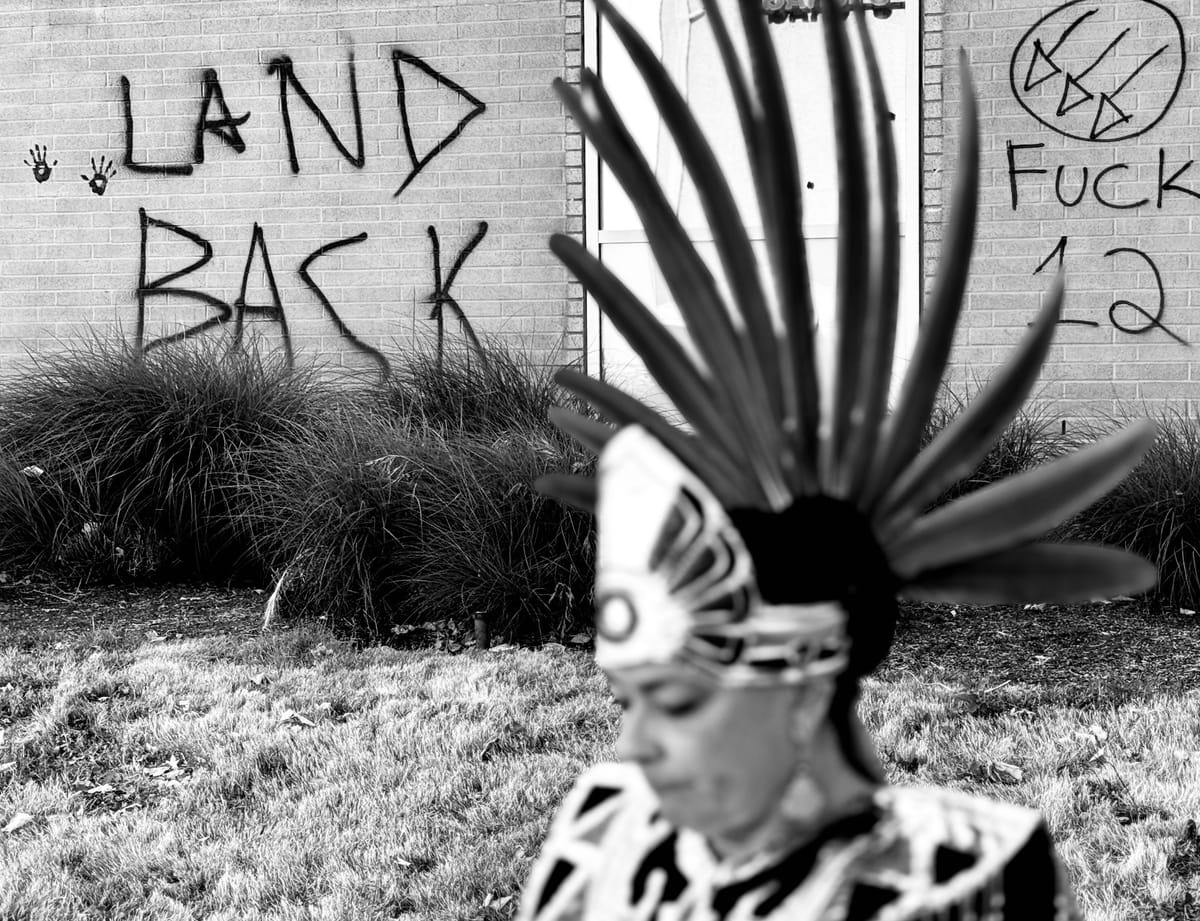
A Portland jury acquitted Indigenous community member Tracy Molina, also known as Cozca, of every charge submitted to them after a two-day trial centered on washable chalk messages written on a police precinct window, and police testimony the jury ultimately rejected.
The case, which at one point included a felony assault charge, collapsed piece by piece under video evidence, contradictory officer statements, and successful defense motions, leaving jurors to unanimously reject the remaining accusations of criminal mischief and assault. What prosecutors framed as vandalism and violence, the jury ultimately found to be neither.
The alleged incidents occurred on March 3, 2023, and April 23, 2023, but were bundled together in a single indictment when charges were later filed.
On March 3, the message on the window of the (in)Justice Center in downtown Portland, OR read “kidnapping is wrong.” On April 23, Molina began writing “¡Feliz cumpleaños Tortuguita,” Spanish for “Happy birthday, Tortuguita,” in reference to Indigenous forest defender Tortuguita, who was murdered by Georgia State Patrol in Atlanta earlier that year. The message was cut off after Molina was arrested, leaving only “!F” visible.
Molina initially faced the following charges:
- Assaulting a Public Safety Officer - Felony Class C (dismissed mid-trial)
- Criminal Mischief in the Second Degree - Misdemeanor Class A (dismissed mid-trial)
- Unlawfully Applying Graffiti - Violation Class A (two counts; removed from the charging instrument)
- Resisting Arrest - Misdemeanor Class A (no complaint)
Additional charges that ultimately went to the jury were:
- Assault in the Fourth Degree - Misdemeanor Class A
- Criminal Mischief in the Third Degree - Misdemeanor Class C (two counts)
- Criminal Mischief in the Second Degree - Misdemeanor Class C
Defense attorney Alex Hamalian characterized the case plainly in opening statements: “This is nothing more than a politically motivated prosecution.”
The State called three witnesses on the first day of trial — all with the Portland Police Bureau. Each was challenged on cross-examination with surveillance footage, physical evidence, and their own incident reports.
Sgt. Freddy Jackson testified first regarding the March 3 incident, claiming Molina used a “spray paint pen” and attempted to flee the scene. Under cross-examination, the defense produced the exact pen submitted into evidence, clearly labeled a “liquid chalk marker.”
After describing how he came to find Molina using a chalk marker on the window, he stated that Molina “ran away” but then came back to identify herself when requested to do so by police. Jackson claimed that she ran away and made it a point to keep bringing this up. Surveillance footage contradicted his statements, and during cross examination, defense brought up the incident report, where Jackson said that he had told Molina she was free to leave the area. A key piece of information that Jackson and Deputy District Attorney Alexander Garcia both conveniently left out when describing the events that transpired to the jurors.
Even after Jackson acknowledged that Molina identified herself when asked, he kept claiming that after that, he had no idea who she was. The sergeant asserted that it is impossible to know who someone is with only their name.
Jackson: she gave me her name. I didn’t know who she was. She ran away from me.
Hamalian: where did she run to? What’s down the sally port?
Jackson: jail
Hamalian: ok. She didn’t go into the abyss, she ran to the jail and sally port. Hence why she said ‘I’ll make it easy for you.’”
Jackson later testified “she said she’d make it easy on me and she went to jail."
Cross-examination grew tense as Jackson's contradictions caught up with him, and he grew visibly frustrated as he raised his voice.
Officer Laura Wiley was the next witness who testified about the April 23 incident, stating she observed Molina writing on precinct windows from her patrol car. Wiley said Molina showed her the marker and explained “it can be washed off with soap and water.”
Wiley testified that Molina claimed she was writing a birthday message, a statement Wiley suggested was untrue and laughed while questioning Molina’s spelling during her testimony. “Happy birthday” doesn’t start with an F, she said as she giggled. After continuously accusing the defendant of lying about the message she attempted to write, defense clarified that “feliz cumpleaños” means “happy birthday” in Spanish.
Wiley also alleged Molina attempted to fight her and “square up.” Surveillance footage showed no such behavior. When pressed on this by defense, Wiley redefined the supposed fighting stance as Molina swearing at her, then fell silent under questioning.
Officer Katrina Insley was up next. Insley showed up as backup to help make the arrest after Wiley called in for assistance. She testified that she was assaulted during Molina’s arrest, claiming Molina scratched her hand with her fingernail while officers attempted to handcuff her. She claims that she grabbed Molina’s hand to put her in handcuffs with her left hand, while her partner grabbed the defendant's other hand. During this motion she claims that the defendant injured her finger by scratching her with her nails.
Under cross-examination, the defense exposed a key inconsistency: Insley testified the injury was to her right hand, despite claiming she used her left hand during the alleged contact, rendering the injury physically impossible under her own account.
After each of the three State law enforcement witnesses got caught lying and/or providing inconsistent testimonies, the fourth State witness was immediately excused, and the fifth officer wasn’t even called up. Shortly after, the State rested their case.
After the State rested, defense moved for acquittals. Angela Lucero, the judge overseeing the proceedings, granted dismissal of:
- Assaulting a Public Safety Officer (Felony Class C) after agreeing it was not possible by the officers own testimony of how the events took place
- One count of Criminal Mischief in the Second Degree (Misdemeanor Class C)
Other counts were sent to the jury.
Before jurors entered the courtroom on Day Two, the defense again challenged Insley’s credibility, arguing that "this sat for years and then turned into felony charges and misdemeanor assault charges at the request of the police officer.” Defense continued to say that officers are professional witnesses and they testify all the time. They have a presentation but with a personal bias in this case when they create testimony that is contrary to all the evidence to bolster their claims. The judge acknowledged contradictions in the evidence but said the defense could argue credibility to jurors.
Molina then took the stand.
She testified about growing up on a reservation, enlisting in the U.S. Navy at 17, and serving during Operation Desert Storm. She described how her Indigenous roots inform her activism, including time spent with the farmworkers’ union, Standing Rock, and anti-ICE protests.
She testified that she was among the first to document federal officers kidnapping protesters off Portland streets in 2020, and that frustration with police reports that did not match reality informed her actions and newfound “hobby” of filming police at demonstrations.
Holding the chalk marker in court, Molina explained its common use, stating they are frequently used by soccer moms to decorate car windows.
Regarding March 3, Molina testified that her intent in writing “kidnapping is wrong” was to force accountability and encourage acknowledgment directly from police. “I mostly wanted police to ask, ‘What kidnapping are you talking about?’ Because one of the kidnappings involved one of their officers.”
Regarding April 23, Molina testified that Earth Day is Tortuguita’s birthday. She described being deeply affected by Tortuguita’s murder, testifying that they were shot 57 times and were her son’s age.
Her intent, she said, was to write “¡Feliz cumpleaños Tortuguita!” and draw 57 flowers around it - one for each gunshot wound, and to represent what she called a Flowery Death.
Revisiting the assault allegations, Molina testified that her fingernails are always kept short. Defense emphasized that police failed to photograph Molina’s hands during booking, failed to bag the officer’s glove she claimed had blood on it as evidence, and did not immediately charge an assault, actions inconsistent from police with the claimed severity of the injury.
In closing arguments, the State argued that the case was “in the videos” and insisted that Molina’s message was not being targeted, rather her actions. He characterized Molina’s movement toward the jail on March 3 as an admission of guilt, despite officers allowing her to leave. He continued to claim that the Molina said things like “fuck you,” and “arrest me,” arguing that these comments are indicative of guilt and escalating the situation.
He repeatedly referenced the dismissed assault allegations, displaying a photograph of a bloody finger and asserting long-term injury, while urging jurors to overlook inconsistencies in police testimony due to the passage of time. He said that the officer required a splint because of this scratch, and that it messed with her ability to operate her firearm, even though the previous day the same officer had already testified that she was still able to use it without issue.
The State's closing statement was short, dramatic, and inspired multiple giggles from the gallery:
Defense attorney Alex Hamalian argued that chalk is harmless, speech is protected, and selective enforcement was at the heart of the case. “I’m proud of her, and I’m going to tell you why,” he said as he pointed to Molina. He continued to talk about the constitution, freedom of speech, freedom of press, said by making certain things a crime it takes the freedoms away.”The State thinks its necessary to prosecute a person for using chalk on a window. why do you think that is? Because of where it is. Because she had the audacity to write on that building, even though they’ll say it isn’t personal. Police didn’t prosecute the removal of the statue of George Washington but they’ll prosecute this? As much as the prosecutor would like you to think she did, she actually didn’t break the law.”
Defense emphasized that charges were refiled two years later with felony assault added only after Molina insisted on going to trial, calling the charges retaliatory. “They charged her with a crime, it included a handful of misdemeanor charges… she says "i’m not guilty, i want my day in court," and then the prosecutors office held back evidence, so the day of trial it got rescheduled… so that upset someone apparently, because two years later they indict her again on the same charges but add felony assault charges.”
Hamalian dismantled the assault allegation point by point, noting the absence of photographs, blood on video, preserved evidence, or immediate charges. "Officer Insley got caught in a lie. Right in front of you, you can sugar coat it however you want, but her right hand was never even on my client, it was her left hand.” He continued, "if you want to believe that a police officer was assaulted and bleeding all over the place like they claimed, don’t you think the least they would do would be to take a picture of the hand? Don’t you think they would charge the person the next day with this assault charge? Why would you leave out an assault when charging them? Because they knew it didn’t happen. They didn’t charge her with it because the evidence wasn’t there."
Defense closed with an emotional statement praising Molina’s service and commitment to her community, prompting applause from the gallery:
“Maybe I am unprofessional. Maybe I don’t always wear the right clothes or say the right things. Maybe sometimes I fight with prosecutors when I don’t agree with them. But if being unprofessional means standing next to somebody who served her country, who served her people, served her nation, served her state, who after everything she has been through and seen, still cares enough to put herself in harm's way, I’m good with unprofessional."
After deliberations, jurors returned the following verdicts:
- Assault in the Fourth Degree - Misdemeanor Class A: NOT GUILTY (unanimous)
- Criminal Mischief in the Third Degree - Misdemeanor Class C (two counts): NOT GUILTY (unanimous)
- Criminal Mischief in the Second Degree - Misdemeanor Class C: NOT GUILTY (10–2 vote)
All charges that reached the jury resulted in acquittal. Tracy Molina, also known as Cozca, was acquitted of every charge submitted to the jury. The felony assault charge and multiple misdemeanors had already been dismissed or removed earlier in the proceedings.
This Was Never About Chalk
In an interview while waiting for the jurors to reach a verdict, Molina described the case as one instance in a long pattern of surveillance, selective enforcement, and retaliation by Portland police, particularly in response to her Indigenous religious practices and political organizing.
“Ever since the lawsuit, I think they’ve targeted me more,” Molina said, referring to a 2018 civil case stemming from protests against the Proud Boys. She ultimately settled the police brutality lawsuit for $5,000, a decision she said was driven by exhaustion rather than accountability. “They never get in trouble for what they do. That’s the closest I’ve ever gotten.”
Molina described repeated arrests and police interventions while participating in Indigenous prayer ceremonies, including at the ICE facility in Portland, where she and others held small ceremonial fires in response to immigration raids. She emphasized that the fires were conducted off federal property, were small enough that the fire department routinely declined to intervene, and were religious in nature. “It was a matchbook fire for prayer,” she said. “All of a sudden I look up and I’m surrounded by aggressive bike cops.”
She explained that the fire was not to be extinguished because of its spiritual significance. “For our sacred fire, you don’t put it out, you let it go to sleep on its own,” she said, adding that officers threatened to stomp it out anyway.
Molina also described an ongoing case involving ringing a bell outside of Portland City Hall, an act she said holds religious significance for multiple Indigenous traditions in the region. She has previously been banned from City Hall for smudging ceremonies, despite smudging not being illegal.
Regarding her April 23, 2023 arrest, Molina said police destroyed her belongings, including her phone and backpack which they cut off of her instead of just unclipping the buckles. Most notably, she said officers incinerated a bag containing copal, an Indigenous medicine used for cleansing and prayer. According to Molina, the destruction was documented in Officer Katrina Insley’s police report and occurred without any testing. “Copal is medicine,” Molina said. “We use it all the time. It’s for cleansing. It’s calming.” She added that destroying it is prohibited under federal law.
Molina believes the targeting is tied in part to her long-standing practice of filming police conduct at protests. “They do this to get me to stop... to stop my videos,” she said.
Revisiting the March 3 incident, Molina rejected the State’s claim that she attempted to flee police. She said she deliberately walked toward the jail’s sally port because it was, at the time, experiencing one of its deadliest years in decades. “When you walk down there it sets off an alarm,” she said. “I wanted them to respond. I wanted to tell them someone is going to die at this address. I was there to warn them.”
She said that after repeated encounters with police, she stopped writing directly on buildings and instead taped messages to walls on cardboard, including statements accusing police of lying in reports. She believes Officer Insley falsely characterized the chalk marker as difficult to remove in order to ensure she would be jailed.
Molina also spoke about the April 23 message that became central to the prosecution’s case. Earth Day, she explained, is Tortuguita’s birthday. Tortuguita, an Indigenous forest defender, was killed by police in Atlanta earlier that year.
“That kind of death is called a flowery death,” Molina said. “A warrior dying in battle, and a woman dying giving birth, those are the best ways to die in our teachings.” She said her intention was to write “¡Feliz cumpleaños Tortuguita!” and draw 57 flowers, to represent both the Flowery Death and each bullet wound.
The jury ultimately rejected the State’s framing of Molina’s actions as vandalism or violence. After two days of testimony dominated by contradictory police accounts and video evidence, every charge submitted to jurors resulted in acquittal.
Tracy Molina walked free yesterday. Her chalk washed away, as did the prosecution’s case against her along with it.
[NOTE: All courtroom observations, commentary, and characterizations above are reported by the author, who was present for the entirety of the proceedings.]