Abolition, Not Fines for Fascism

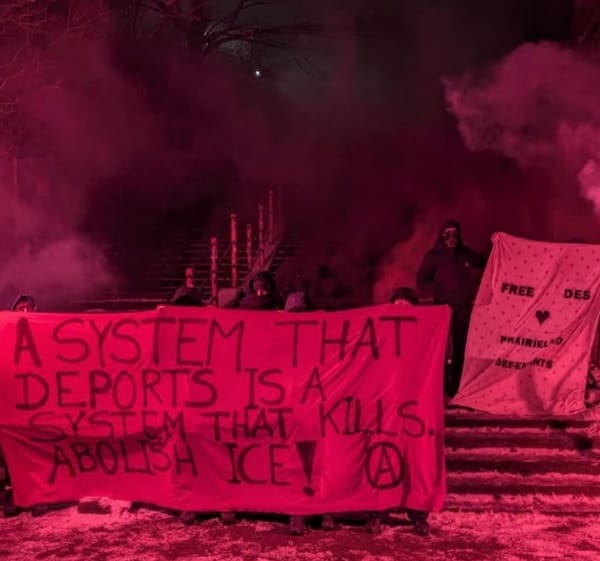
Portlanders have repeatedly shown up to City Hall with one message: We refuse to negotiate the terms of our own oppression. People weren’t there for symbolic accountability, or for another round of policy cosplay. They came to demand the obvious: Shut the ICE facility down. Completely and permanently.
To better understand how we got here, with hundreds of people filling City Hall and over 100 days of continuous protest, it’s worth looking back.
In 2011, Portland City Council unanimously approved the permit for Rodney Grinberg to develop the ICE facility in Portland, Oregon. And while the history of advocating for immigrant rights in this city goes back much further than the day it opened, protests at the facility have been happening ever since. While Occupy ICE in 2018 is likely the most well known and documented, community members and activists have continued to show up, hold vigils, direct actions, and organize many other forms of protest.
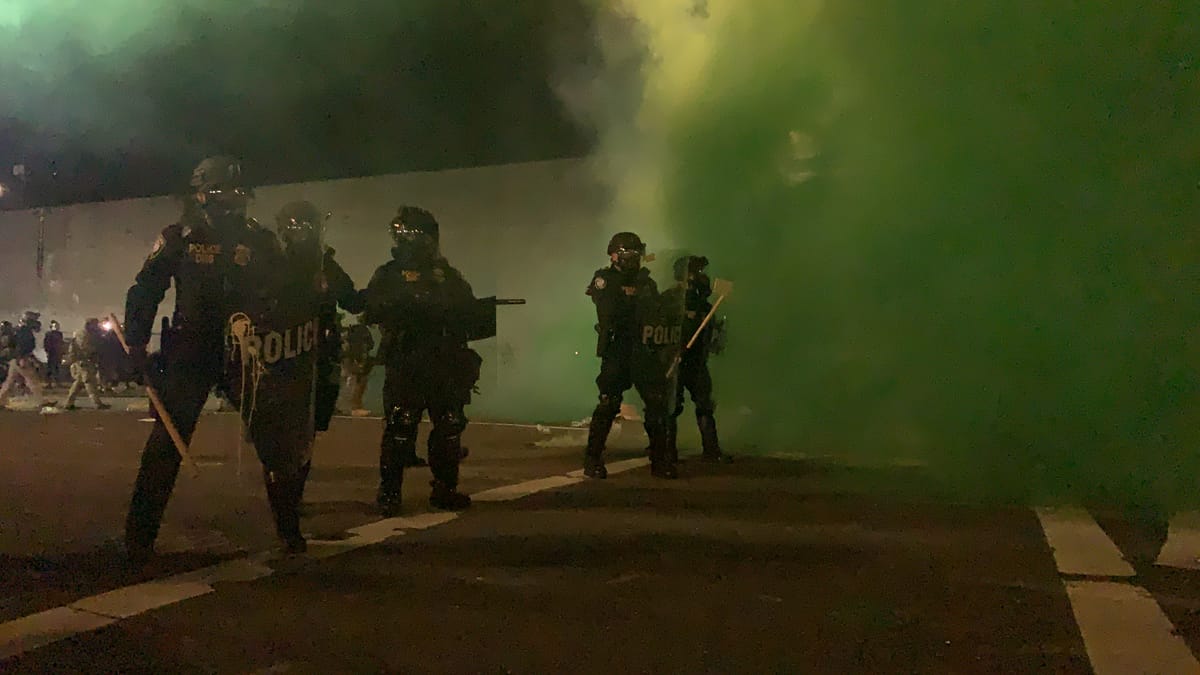
This year, the facility saw its most sustained protests in recent years: over 100 days of continuous demonstrations. And while violence perpetuated by ICE is nothing new, the undeniable escalations by the fascist American regime, and the community’s response to that violence, have attracted more attention from local officials and Portland City Council members.
What people got at the most recent council meeting, however, was a masterclass in liberal evasion: officials twisting abolitionist language into a shield for complicity, nonprofits laundering harm through “service,” and political actors weaponizing identity while dismissing the very communities they claim to uplift.
To understand what happened inside and outside that meeting, I spoke with two community members who’ve been in this fight longer than council members have been in office: Susie Shelter, who relaunched the petition to revoke ICE’s permit (which has over 18,000 signatures as of publishing), and has been doing this work for nearly a decade; and Pedro Anglada Cordero, a community advocate who moved here from Puerto Rico in 2004. The pair has also operated an anarchist mutual aid network distributing food based solely on donations for nearly 20 years.
What they describe is not confusion. It’s not bureaucracy. It’s not complexity. It’s moral cowardice dressed up as process. In this instance, that cowardice takes its form in a manufactured narrative that politicians have been leaning on for months.
The Manufactured Lie: “The ICE Facility Helps Immigrants”
Let’s get this out of the way: There is no immigrant community begging for ICE to stay open and in business. The people pushing this narrative are politicians with an agenda and nonprofits with their funding on the line.
Shelter traced the narrative back to one person repeatedly held up by council members as “the immigrant rights advocate” warning that closure would “harm the community."
That person in question? Jessica Maravilla, lobbyist and policy director for the ACLU. “She’s being paid, as a member of a carceral nonprofit… She is not a community advocate. You cannot call yourself that if you’re also a lobbyist,” said Shelter.
After presenting the petition to revoke the ICE permit, Cordero says he was put in touch with council member Tiffany Koyama Lane, who then redirected him and put him in touch with Maravilla. Cordero said that she just went on about the harms in closing down the facility, saying that it was essential to remain open.
A Street Roots article published on June 23rd included much of this same rhetoric. In it, another lobbyist and executive director for the ACLU Sandy Chung argues that the closure of the facility would not be beneficial to the community. The article also features a written response from Cordero pushing back against this narrative, along with Chung’s response to him.
The thing is, none of this happened by accident. This is a tactic, one that we have seen before. From COINTELPRO to the Red Scare to every movement that’s ever threatened power, officials find a palatable “representative,” often ones who weaponizes their identity, elevate them, and then use them to erase the lived experience of the people actually resisting. In fact, these arguments were first brought up in response to not just the desire to shut down the Portland ICE facility, but as a response to the protests that have been happening outside the facility since the start of the summer.
Shelter watched it happen in real time: “To see high-powered women use identity politics to proliferate a harmful narrative… while erasing Pedro’s voice… it was almost too much. But my fire is still lit.”
Shelter and Cordero eventually sat down with Maravilla in a meeting along with a few orgs and community activists from Tacoma, Washington. Just a few hours away from Portland, Tacoma has an actual ICE detention center, as opposed to Portland’s sub field office which can legally (though often violated) only hold detainees for 12 hours. The ICE detention center in Tacoma is often where people kidnapped by ICE in Oregon are transported as they face deportation.
Maravilla suggested that community activists focus their efforts on the Tacoma detention center, once again making the argument that the closure of the Portland facility would further complicate the legal and logistic process for those who face deportation and make it more difficult for lawyers to advocate for their release.
Cordero responded, "If we don’t fight it with an abolitionist approach, if we continue doing it like this, basically we subscribe to a continuation of the oppression."
How Liberals Co-Opt Abolitionist Language
Cordero calls it what it is:
“It’s the classic playbook of liberal politics. They are completely in line with the status quo, not disrupting systems. They are using abolitionist and radical talking points to confuse the audience into thinking that their approach is actually radical and is abolitionist while helping to maintain the status quo and being complicit with ICE."
We’ve seen this before, too. During the Civil Rights Movement, politicians condemned racism while protecting segregation. During the George Floyd uprisings, cities “declared” racism a public health crisis while increasing police budgets. Now in Portland, officials talk about “harm reduction” and “community safety” while giving permits to an agency responsible for disappearances, detention, surveillance, deportations, and constant human rights abuses.
Cordero says that the proposed fee structure and various policy proposals, such as making sure agents cannot wear masks, only works to normalize fascism and provide comfort and numbness to those who oppose ICE.
Are Fees Just Fascism in a Softer Font?
Enter Councilor Angelita Morillo, who ahead of the meeting at City Hall had a proposal for an “impact fee,” which is more or less a bureaucratic fantasy.
As reported by OPB: This policy would introduce a new fee for private property owners whose building is leased to be used as a detention facility. This would exempt all government-owned property, like the Multnomah County Detention Center or a federally owned ICE detention facility (which Oregon doesn’t currently have). The ICE facility in Portland is currently the only building that meets this description.
The proposed fee would pay for any costs tied to the detention center’s impact in the neighborhood like it’s a late library book. The draft legislation shows that the fees are largely protest related, such as police overtime, any environmental cleanup of chemical munitions, and financial support to the homes and businesses impacted by “detention facility operations.”
Shelter says that at best "it’s something someone might propose in a collegiate neoliberal policy seminar.” This fee wouldn’t even cover police overtime, the same police who brutalized protesters and tore down medical tents. It’s a way to normalize ICE, not hold them accountable.
“A fee is just normalization of fascism," said Cordero. He continued with how this parallels exactly what happened under Jim Crow, when officials replaced structural change with fines, licensing schemes, and “compliance measures” that allowed violence to continue under a legitimate veneer. It’s the same logic that upheld Japanese internment, the war on drugs, and post-9/11 surveillance. In other words, regulate the violence, don’t end it.
When documents proved the Portland ICE facility violated how long they could hold people they had detained, some council members began shifting their tone but not their ideology. They still chose process over people and paperwork over liberation. “This is not black mold. This is not a broken faucet. This is an institution violating human rights with bravado — and the City wants to give them a permit to keep doing it,” said Cordero.
On December 3rd, Portland City Council voted 9-2 in favor of the “impact fee” ordinance.
Nonprofits Aren’t Neutral. They’re Funded
A major part of this political theater involves nonprofits stepping into radical spaces claiming to represent “those closest to the issue.” But state-funded organizations are structurally barred from taking abolitionist positions.
Cordero lays it out. When speaking on various nonprofit organizations focused on helping immigrants, he says that “they do important work… but they have a gag order because of who funds them. They’re not abolitionist orgs. Their analysis will always be tainted by the system they’re part of.”
Despite this, nonprofits became the voice City Council has repeatedly uplifted, echoing the harmful line that ICE should remain open, all while silencing and patronizing community advocates who have been hard at this work for years, and who themselves are heavily impacted by this violence.
This is how movements are historically neutralized. Elevate a respectable intermediary, let them speak for the oppressed, marginalize the radical base, claim consensus, do nothing. It worked against Black Panthers, AIM, ACT UP, and countless others. And it’s being deployed again in Portland.
City Hall Meeting
Shelter told WWFU that while inside, some council members such as Sameer Kanal actually listened to community members. Others, such as Lane and Morillo, giggled, traded whispers, and at one point literally walked out as community members were speaking to them.
After countless failed attempts to speak at city hall, due to either agenda items being canceled at the last minute or being placed last on the list, Shelter said that her and Cordero finally got an opportunity to make their voices heard. She said that she had been trying to get the opportunity to speak at one of these meetings about the revocation of the ICE permit and the need to shut the facility down and make sure their voices were heard. She added that she wanted to let council members know the fee structure plan was not enough, and “to point it out as a capitalist and neoliberal and racist plan.”
After voicing her opinion, a DSA member told Shelter “we think you should fight ICE like you fight Morillo.”
While speaking on this exchange, Shelter recalled “looking across the room and seeing all these people who have been physically dragged away, who have been arrested and taken to weird jails outside of the city by the fascist government, all for believing so much in what they are doing... and this asshole is eating pizza and just there to prop up politicians and saying this while so many people in the room have been fighting against ICE? I had to say no, mother fucker, fuck you.”
Feeling frustrated and ignored, Shelter said that she “self ejected” and left the room.
Cordero immediately chimed in, adding that “people who call themselves radical are undermining the most important issue right now in this country. We’re talking about a secret police, taking people out of their homes, their communities, arresting, detaining, deporting people. And they want to isolate us to the point of trying to make us invisible? Shame on them.”
This type of opportunism is not a historically new concept, the tendency for progressive groups to treat state violence against marginalized communities as a distraction from their own priorities goes far back. It happened during the Chicano Movement, during Black liberation struggles, during the fight against Japanese internment, and during every wave of immigrant resistance and more.
A Permit and Some Fines for Human Rights Abuses
ICE wants to be seen. They want to be feared. Their abuses aren’t accidents. They are strategic. And Portland’s City Council, by entertaining a permitting process and fee structure, is offering them legitimacy, argues Cordero: “They want to hit ICE on the hand… say don’t do that again… and hand them a permit to continue abusing people. We’ll get a little cash,” he says as he shrugs.
Shelter interjected, “and that is exactly why we have to shut this motherfucker down.”
Cordero: the city is missing the point, by engaging in a bureaucratic process where they’re somehow going to mitigate human rights violations through a permitting process…
Shelter: which is the entire history of colonialism and US policy towards Indigenous people repeating once again. But the scary thing is that its repeating through people who will get up on that mic and say, my grandparent this or my grandparent that. And still ride the bike.
We’ve Been Here Before. We Know What Wins
History is full of moments when people were told to compromise with injustice:
- Abolitionists were told to regulate slavery, not end it.
- Civil rights organizers were told to wait for “gradualism.”
- Anti-war protesters were told to trust intelligence agencies.
- Queer activists during the AIDS crisis were told to follow the rules while their communities died.
Every meaningful victory came from rejecting the polite path, from refusing to let power dictate the terms of liberation. Portland is at that crossroads now.
Abolition Isn’t a Comment Period. It’s a Demand
If you’re reading this, something we all need to understand is that this moment will be remembered. Either as the time Portland finally broke with authoritarianism, or the time it allowed ICE to entrench itself deeper under a progressive veneer. Community members have been clear that the city needs to continue to hear that Portland reject fines, permitting processes, neoliberal harm-laundering, identity based smokescreens, the silencing of immigrant and Indigenous voices, and the kidnappings and disappearances of our neighbors.
Abolition isn’t a branding exercise, or a fee schedule, or a conditional permit. It’s a line in the sand. Portland has an obligation to choose which side it stands on.